Most common sum of two dice: why 7 wins (count the 36 pairs)
Roll two dice and add them: 7 comes up more than any other sum. Lay out all 36 pairs and the diagonals show why: 6 pairs make 7.
What is the most common sum of two dice? Roll two dice, add them up, and 7 shows up more often than any other total. Most people know this from board games. Fewer can say why, and the reason is a nice lesson in how to think about probability: don't count the totals, count the pairs.
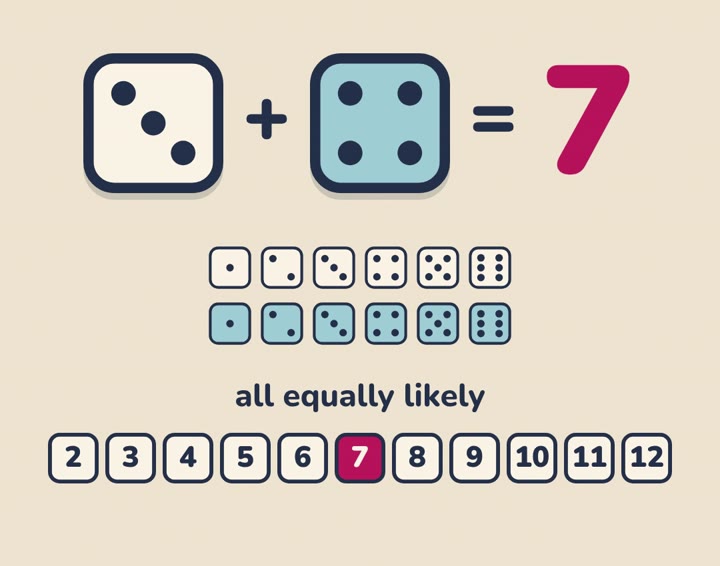
What are the rules?
One die is white, one is blue. Each lands on 1, 2, 3, 4, 5 or 6, every face equally likely, and the dice don't affect each other. Add the two faces. The smallest total is 1 + 1 = 2, the largest is 6 + 6 = 12, so there are eleven possible totals.
Why aren't the totals equally likely?
It's tempting to think each of the eleven totals has a 1 in 11 chance. It doesn't, because the totals are not the equally likely cases. The pairs are. White 3 with blue 4 is exactly as likely as white 6 with blue 6, but the total 7 can be made in several ways and the total 12 in only one.
So the job is to list the pairs, then see how many of them land on each total.
What are all the possible pairs?
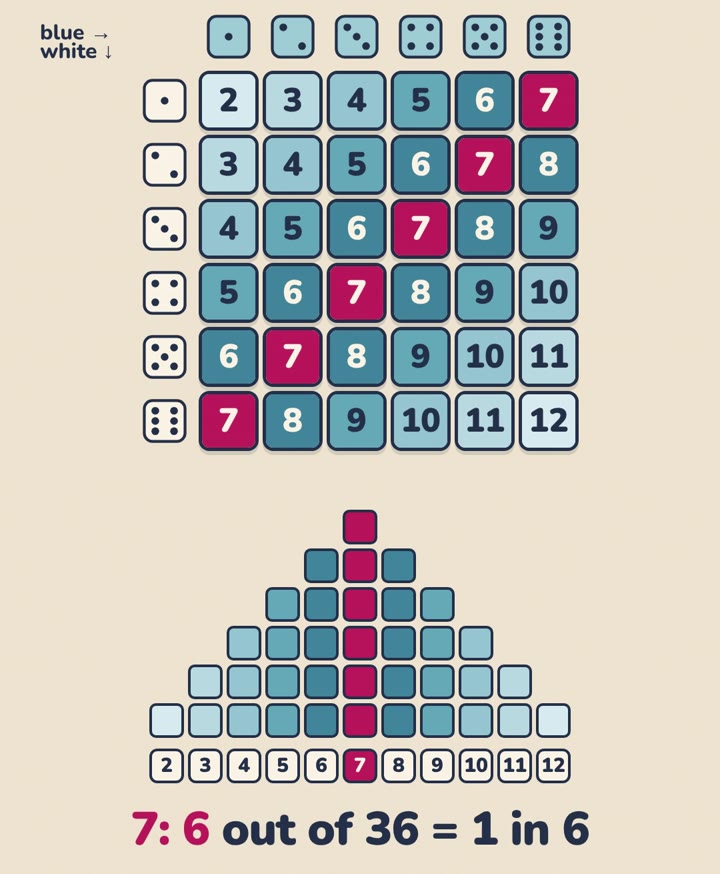
Every white face can meet every blue face. Put white down the side and blue across the top and you get a 6 by 6 grid: 36 pairs, each exactly as likely as any other.
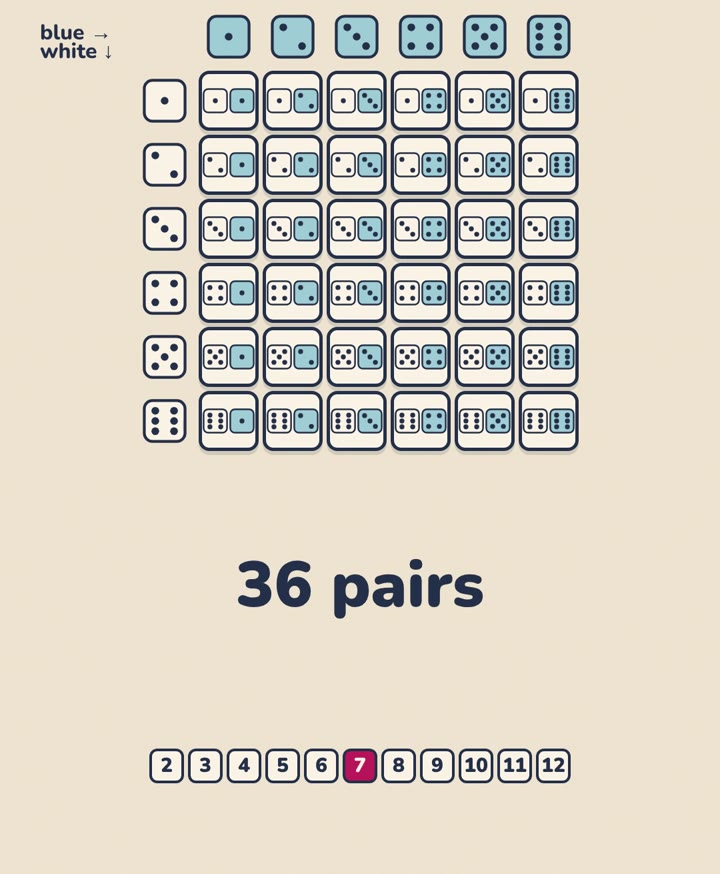
White 2 with blue 5 and white 5 with blue 2 are different cells. The dice are different colours, so you can tell them apart, and even if they weren't, there would still be two ways for the dice to fall.
Where do the totals sit in the grid?
Pairs with the same total share a diagonal. Moving one step right adds 1 to the blue die, and moving one step up takes 1 from the white die, so the total stays the same along each diagonal running from bottom left to top right.
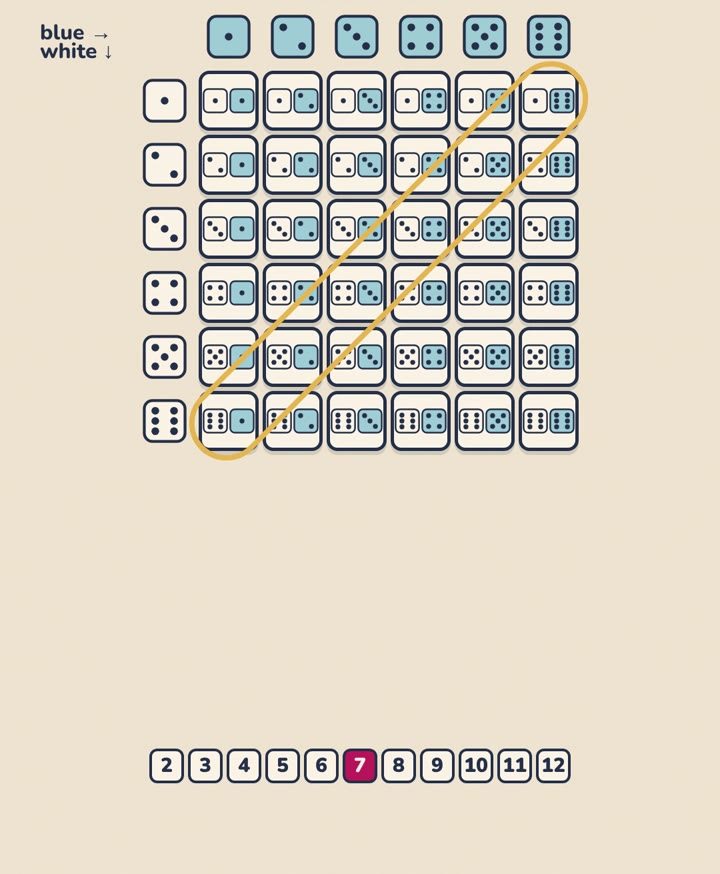
Now walk the diagonals one at a time, from the top-left corner:
- 2 has one pair: 1 and 1.
- 3 has two: 1 + 2 and 2 + 1.
- 4 has three, 5 has four, 6 has five.
- 7, the longest diagonal, corner to corner, has six.
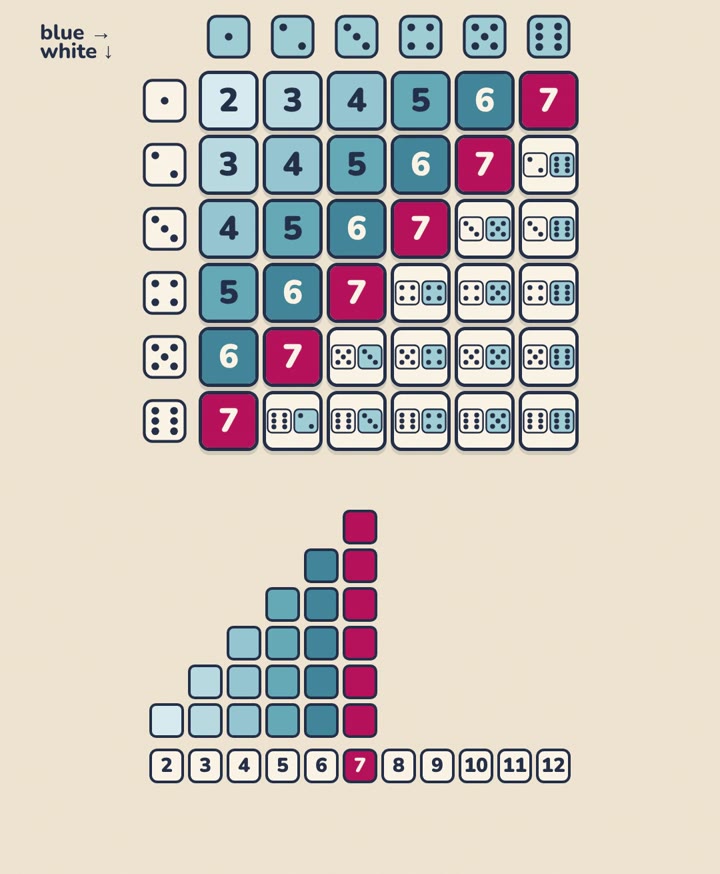
After 7 the diagonals shrink again: 8 has five, 9 has four, 10 has three, 11 has two, and 12 has just one, double six. Stack each diagonal's pairs under its total and you get a triangle, with 7 at the peak.
| Total | 2 | 3 | 4 | 5 | 6 | 7 | 8 | 9 | 10 | 11 | 12 |
|---|---|---|---|---|---|---|---|---|---|---|---|
| Pairs | 1 | 2 | 3 | 4 | 5 | 6 | 5 | 4 | 3 | 2 | 1 |
The pairs add up to 36, as they should.
So what is the probability of rolling a 7?
Six pairs out of 36: 6/36 = 1/6. The next most likely totals, 6 and 8, have 5 pairs each, 5/36. The least likely, 2 and 12, have 1 pair each, 1/36.
Why does 7 win?
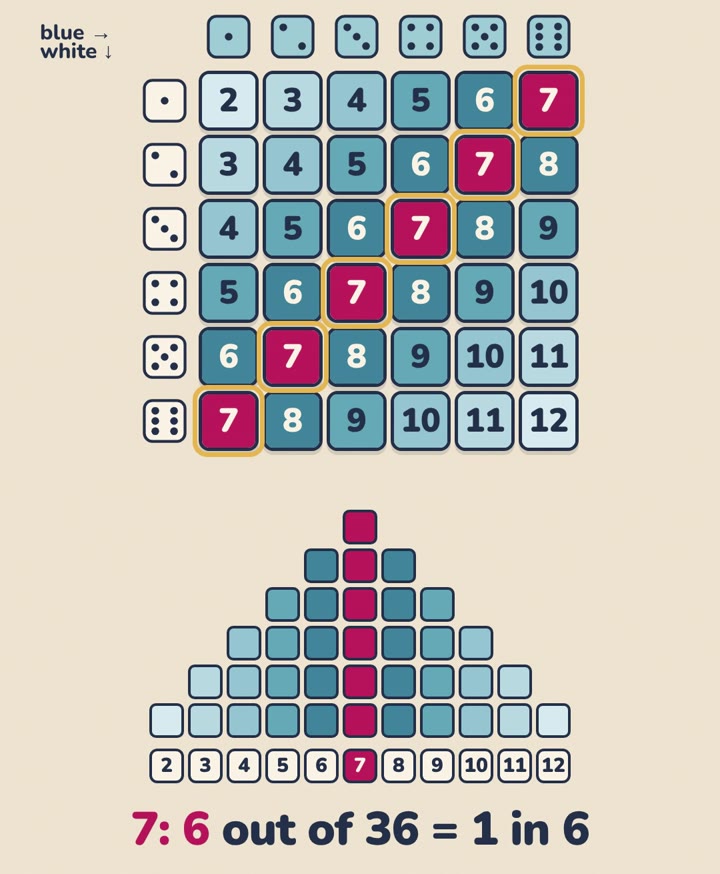
Whatever the white die shows, exactly one blue face makes 7: white 1 needs blue 6, white 2 needs blue 5, and so on down to white 6 needing blue 1. Every row of the grid has a 7 in it. No other total does that. For 6, white 6 would need a blue 0; for 8, white 1 would need a blue 7. Every other total misses at least one row, so its diagonal is shorter.
Check it with code
Count all 36 pairs exactly, then simulate 360,000 rolls:
from collections import Counter
from fractions import Fraction
from itertools import product
import random

pairs = list(product(range(1, 7), repeat=2))    # (white, blue): all 36 equally likely pairs
count = Counter(w + b for w, b in pairs)        # how many pairs make each total
for total in range(2, 13):
    print(total, count[total], Fraction(count[total], 36))

rng = random.Random(3)
n = 360_000
sevens = sum(rng.randint(1, 6) + rng.randint(1, 6) == 7 for _ in range(n))
print(f'simulated 7: {sevens / n:.4f}')
Output:
2 1 1/36
3 2 1/18
4 3 1/12
5 4 1/9
6 5 5/36
7 6 1/6
8 5 5/36
9 4 1/9
10 3 1/12
11 2 1/18
12 1 1/36
simulated 7: 0.1655
The exact count gives 1/6 = 0.1667 for a 7, and the simulated rolls land right next to it.
Try it
Roll three dice instead. Which total is the most common? The grid becomes a cube of 6 × 6 × 6 = 216 triples, and the totals run from 3 to 18. Try counting the triples for the totals near the middle.