Struct memory layout in C++: the real bytes, offsets and padding
Struct memory layout in C++, byte by byte: char, short, int in 8 bytes, one padding byte, and a real dump read low byte first: 41 00 02 01 e8 03 00 00.
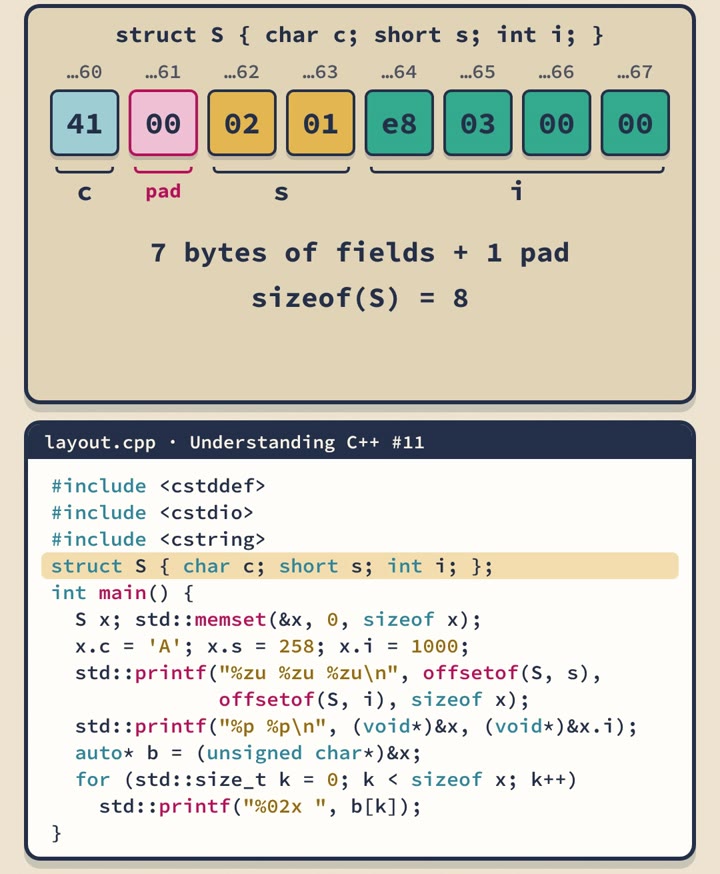
Struct memory layout in C++ is simple to state: a struct's bytes are its members' bytes, in declaration order, with padding bytes wherever a member's alignment needs a gap. The best way to see it is to print the real bytes. struct S { char c; short s; int i; }; has 1 + 2 + 4 = 7 bytes of members, and sizeof(S) is 8.
This is the written version of Understanding C++ #11. Every number below is printed by one program, compiled with g++ -std=c++20 -Wall -O2 (GCC 13) on x86-64 Linux, where short is 2 bytes with an alignment of 2, int is 4 bytes with an alignment of 4, and memory is little-endian.
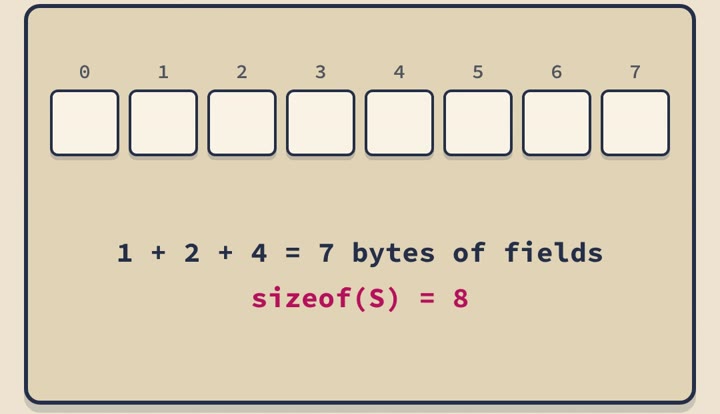
Where does each member go?
The program first zeroes all eight bytes with std::memset, then stores x.c = 'A', x.s = 258 and x.i = 1000. offsetof(S, member) gives each member's distance in bytes from the start of the struct.
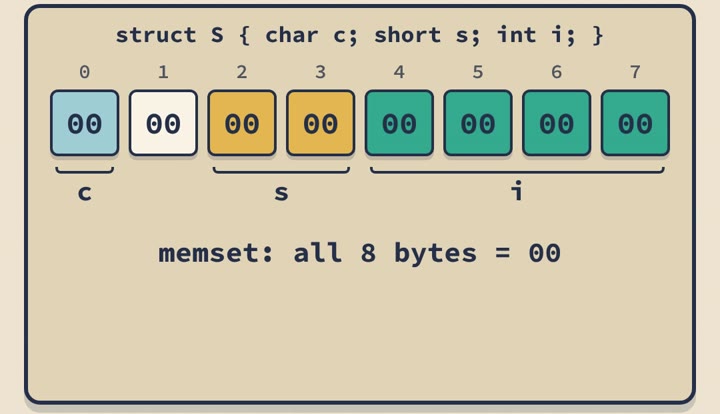
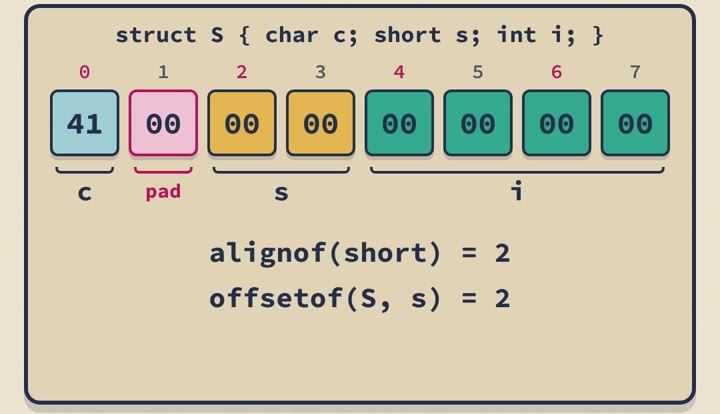
c is a char, so it takes offset 0. The next free offset is 1, but a short must start at an even offset (alignof(short) is 2), so the compiler leaves byte 1 as padding and offsetof(S, s) prints 2. s takes offsets 2 and 3, and i starts at 4, a multiple of 4, with no gap needed. That fills exactly 8 bytes, which is already a multiple of the struct's alignment (4), so there is no padding at the end.
| offset | 0 | 1 | 2 | 3 | 4 | 5 | 6 | 7 |
|---|---|---|---|---|---|---|---|---|
| member | c | pad | s | s | i | i | i | i |
| byte | 41 | 00 | 02 | 01 | e8 | 03 | 00 | 00 |
How do you read the bytes?
The last loop walks the struct through an unsigned char* and prints each byte in hex, lowest address first: 41 00 02 01 e8 03 00 00.
- Offset 0 is
41: the character'A'is 0x41 (65). - Offset 1 is
00: the padding byte. It reads 0 here only becausememsetzeroed it and nothing wrote over it. The language does not promise any particular value in padding after you store into members, so never rely on it. - Offsets 2 and 3 are
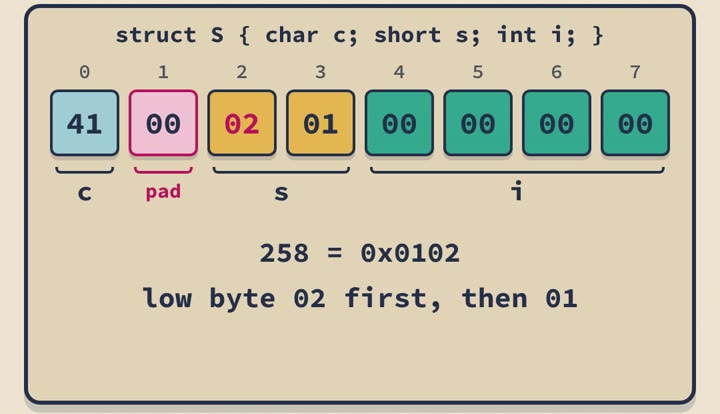
02 01: 258 is 0x0102. x86-64 is little-endian, so the low byte,02, comes first, at the lower address. - Offsets 4 to 7 are
e8 03 00 00: 1000 is 0x000003e8, again low byte first, with two zero bytes on top.
What is the address of a member?
A member's address is the struct's address plus its offset. The second line of output shows &x and &x.i for one run. The addresses change every run (the stack is placed at a random address), but &x.i is always &x plus 4. In this run x sat at 0x7ffdc47d7b60 and i at 0x7ffdc47d7b64.
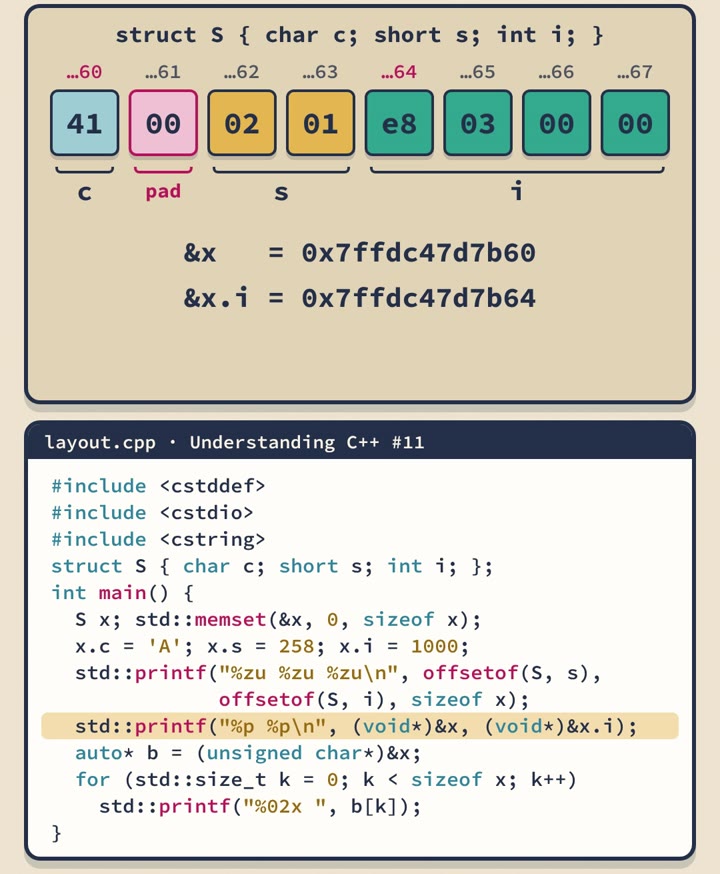
So a struct is not a container with a separate structure of its own. It is a run of bytes: each member at a fixed offset known at compile time, in the order you declared them, with gaps for alignment. Accessing x.i is reading 4 bytes at &x + 4.
The program and its output
#include <cstddef>
#include <cstdio>
#include <cstring>
struct S { char c; short s; int i; };
int main() {
  S x; std::memset(&x, 0, sizeof x);
  x.c = 'A'; x.s = 258; x.i = 1000;
  std::printf("%zu %zu %zu\n", offsetof(S, s),
              offsetof(S, i), sizeof x);
  std::printf("%p %p\n", (void*)&x, (void*)&x.i);
  auto* b = (unsigned char*)&x;
  for (std::size_t k = 0; k < sizeof x; k++)
    std::printf("%02x ", b[k]);
}
2 4 8
0x7ffdc47d7b60 0x7ffdc47d7b64
41 00 02 01 e8 03 00 00
Line by line: 2 4 8 are offsetof(S, s), offsetof(S, i) and sizeof(S); the two addresses are &x and &x.i (yours will differ, 4 apart); the last line is the eight bytes of x.
Try it
Keep everything the same but store x.i = 258 instead of 1000. What byte is at offset 4 now, and what are all eight bytes? Work it out from the little-endian rule, then run the program to check.