Probability of at least one six with two dice: count the 36 cases
Roll two dice: what's the chance at least one shows a six? Lay out all 36 equally likely pairs and count: 11 out of 36, not 1 in 3.
What is the probability of at least one six when you roll two dice? It's one of the first questions anyone asks about probability, and a surprising number of people get it wrong. The quick answer many give is 1 in 3: one die has a 1 in 6 chance, so two dice must have 2 in 6. The real answer is 11 out of 36, a little less than that.
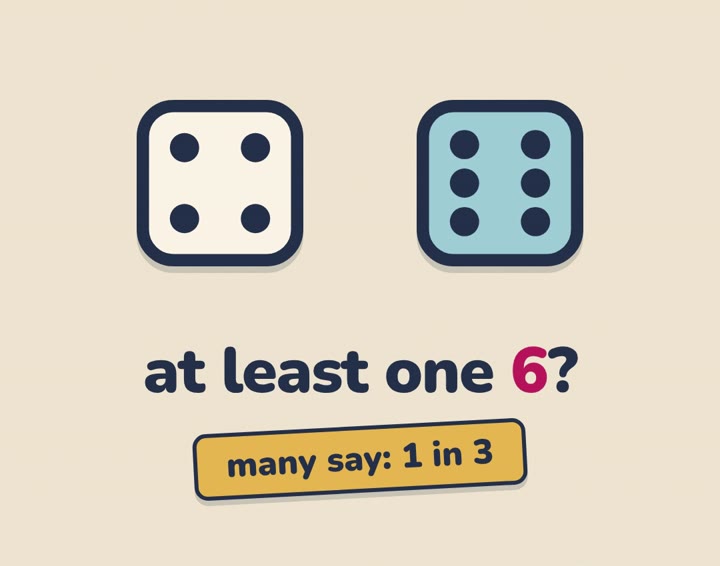
The way to see it is the way to see almost every probability question: stop calculating, and count.
What are the rules?
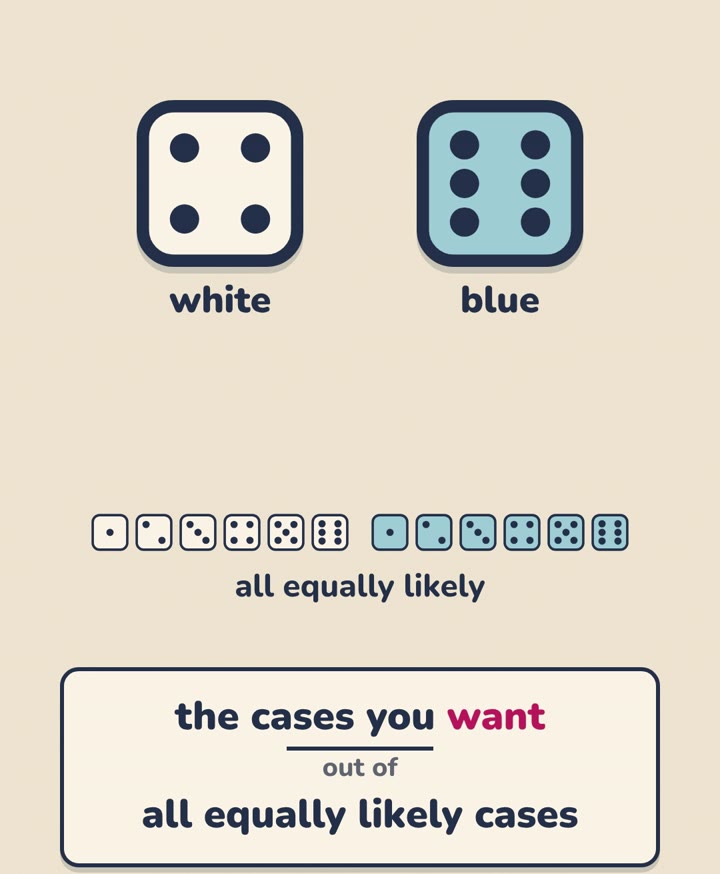
One die is white, one is blue. Each one lands on 1, 2, 3, 4, 5 or 6, and every face is equally likely. The dice don't affect each other.
We want the chance that at least one of them shows a six: the white one, the blue one, or both.
What is probability, really?
Probability is counting: the cases you want, out of all the equally likely cases. That's the whole definition. The hard part is never the division at the end; it's listing the cases correctly, so that each one really is equally likely and none is counted twice.
What are all the possible cases?
Pair every white face with every blue face. White 1 can meet blue 1, 2, 3, 4, 5 or 6: that's six cases. White 2 meets the same six blue faces, and so on up to white 6. Lay them out as a grid, white down the side and blue across the top, and you get six rows of six: 36 cases, each exactly as likely as any other.
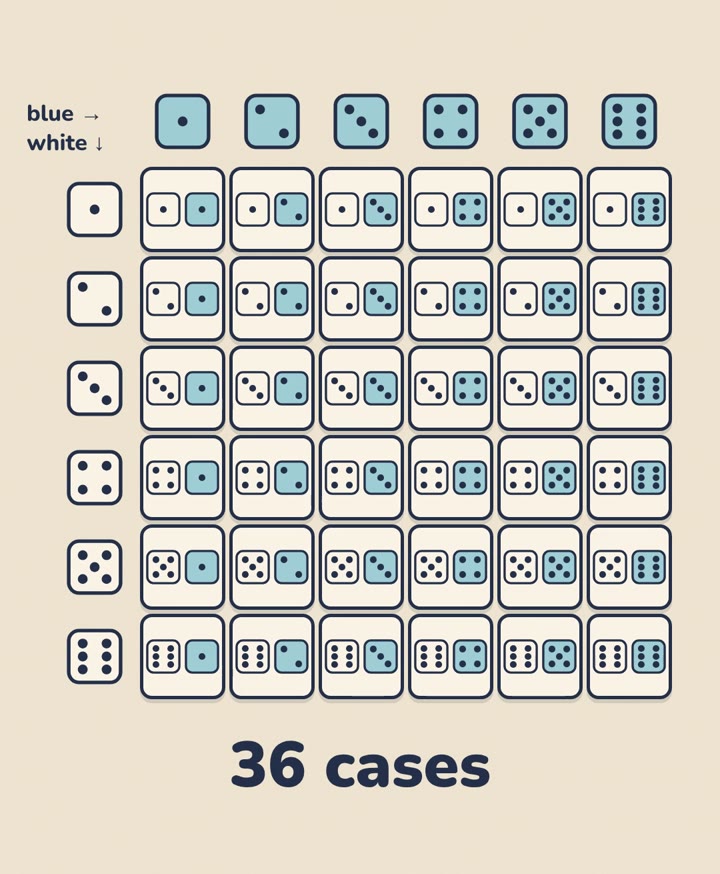
Note that white 2 with blue 5 and white 5 with blue 2 are different cases. The dice are different colours, so you can tell them apart. Even if they were the same colour, the physics wouldn't change: there would still be two ways to roll a 2 and a 5.
Which cases have a six?
Play out each row:
- When white shows 1, 2, 3, 4 or 5, only one pair in the row works: the one where blue shows 6. That's 5 cases.
- When white shows 6, every pair in the row works, whatever blue does. That's 6 more.
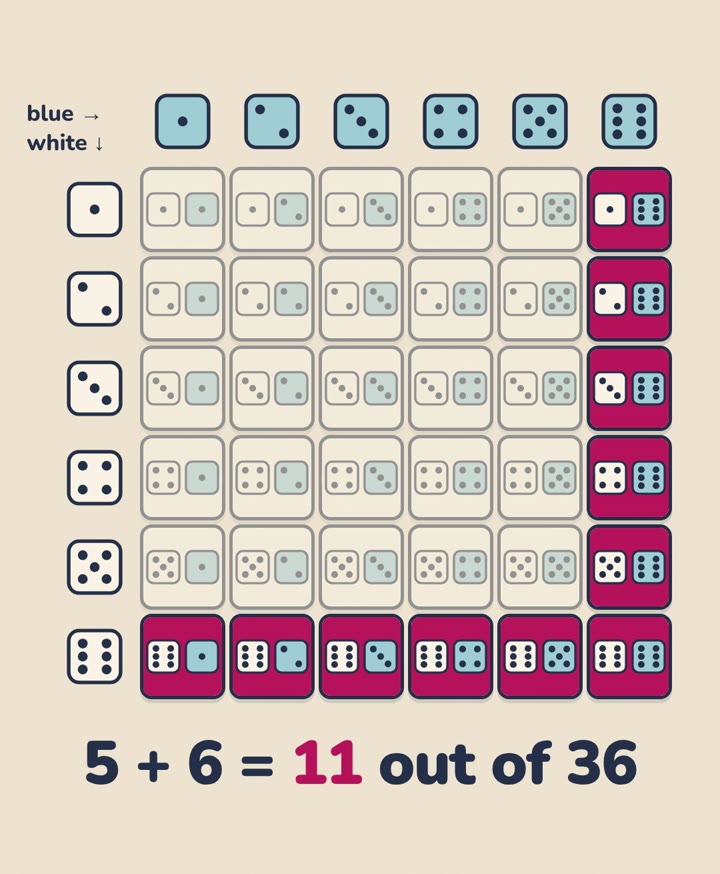
| White die | Pairs with a six | Count |
|---|---|---|
| 1 to 5 | only blue 6 | 1 per row, 5 in all |
| 6 | every blue face | 6 |
| Total | 11 out of 36 |
So the probability of at least one six is 11/36, about 0.306.
Why isn't it 1 in 3?
One in three of 36 cases would be 12. The guess of "1 in 6 plus 1 in 6" adds the white-six row (6 cases) and the blue-six column (6 cases), but those two lines cross at double six. Double six is one case, not two, so adding the row and the column counts it twice. Take the extra one away and you're back to 11.
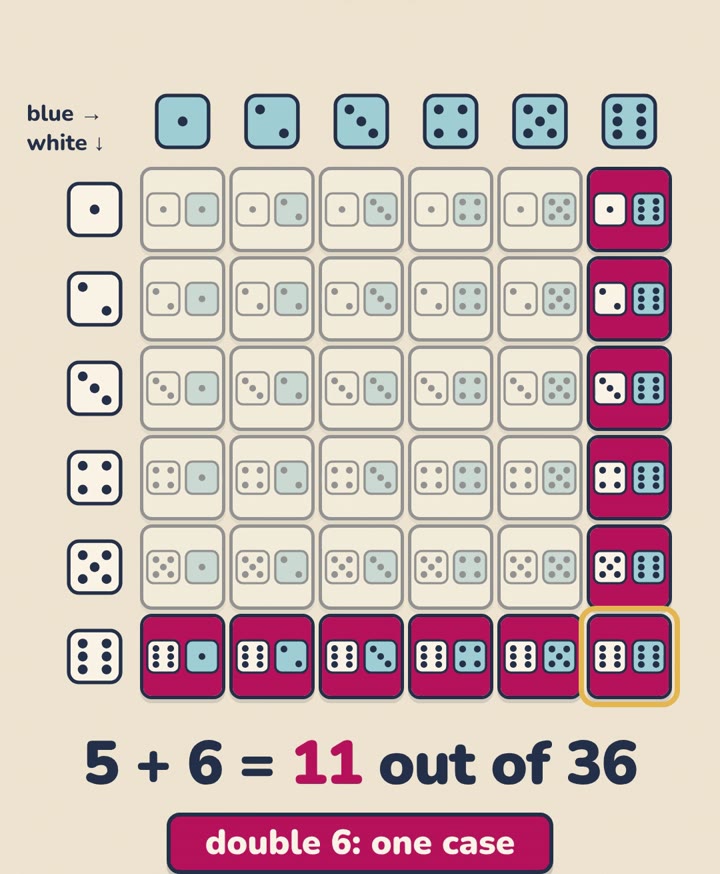
That's the lesson in one sentence: count before you calculate. If you had written down the grid first, the overlap would have been impossible to miss.
Check it with code
Count the 36 pairs exactly, then confirm with a simulation:
from fractions import Fraction
from itertools import product
import random

cases = list(product(range(1, 7), repeat=2))   # (white, blue): all 36 equally likely pairs
want = [c for c in cases if 6 in c]             # at least one six
print(len(want), 'out of', len(cases), '=', Fraction(len(want), len(cases)))

rng = random.Random(2)
n = 200_000
hits = sum(6 in (rng.randint(1, 6), rng.randint(1, 6)) for _ in range(n))
print(f'simulated: {hits / n:.4f}')
Output:
11 out of 36 = 11/36
simulated: 0.3059
The exact count says 11/36 = 0.3056, and 200,000 simulated rolls land right next to it.
Try it
Roll three dice instead. Is at least one six more likely than not? The grid becomes a cube of 6 × 6 × 6 cases. Count the ones with no six at all first, then take them away from the total.