Probability of a full house: counting all 3,744 hands
The probability of a full house in five-card poker, counted box by box: 13 × 4 × 12 × 6 = 3,744 of 2,598,960 hands, about 1 in 694.
The probability of a full house is the chance that five cards dealt from a shuffled deck make three of one rank plus two of another, like three kings and two sevens. You don't need a formula to find it. Build every full house one choice at a time, count the choices, and compare with the number of all hands.
What are the rules?
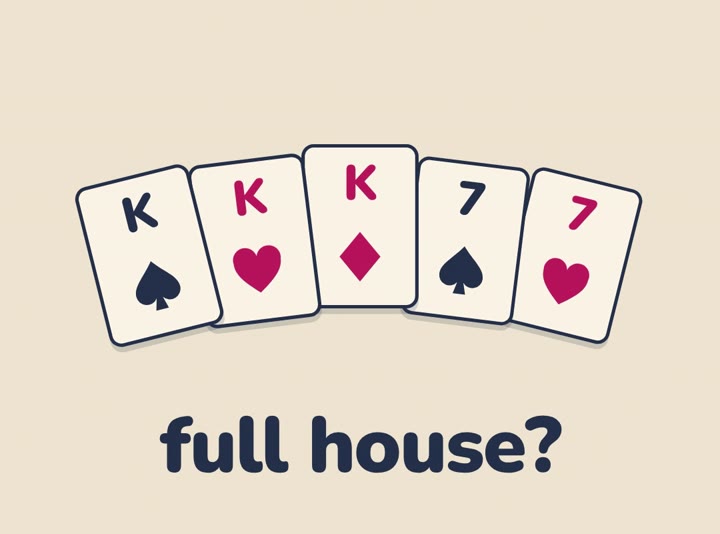
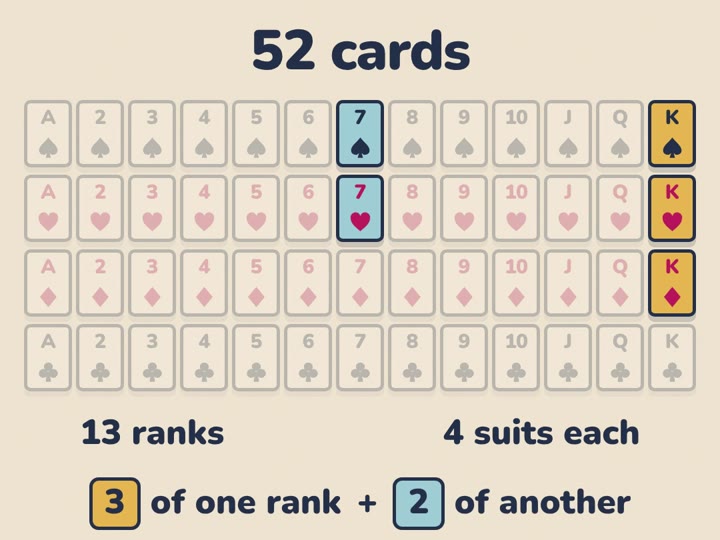
A deck has 52 cards: 13 ranks (A, 2, 3 ... 10, J, Q, K), each in 4 suits. Five cards are dealt, and every five-card hand is equally likely. A full house is three cards of one rank plus two cards of another rank. Three kings and two sevens is one; three kings and two kings is impossible, since there are only four kings.
How do you build a full house?
Every full house is fixed by four choices. Put each one in a box and lay out its options.
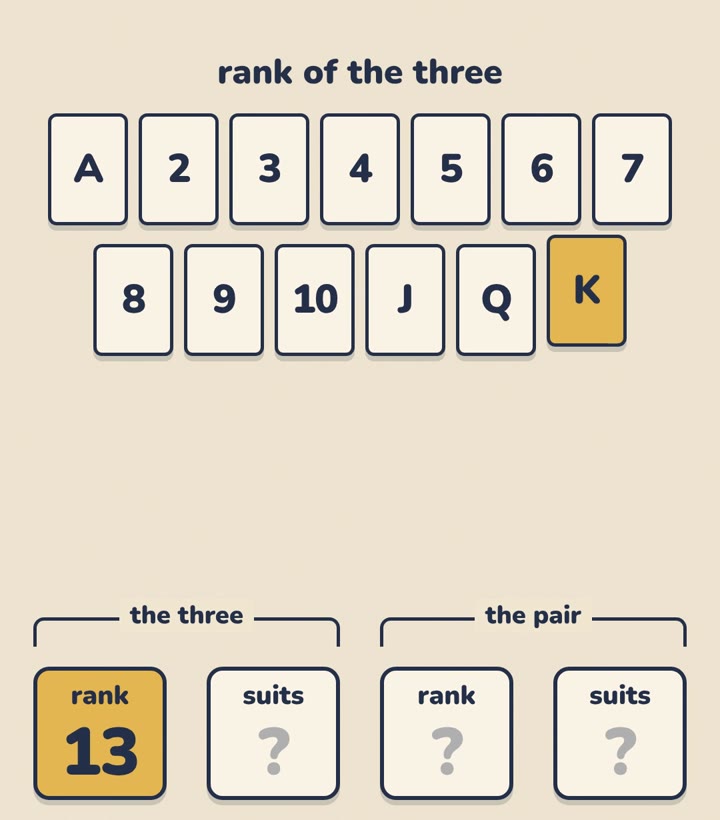
Box 1: the rank of the three. Any of the 13 ranks. Say kings.
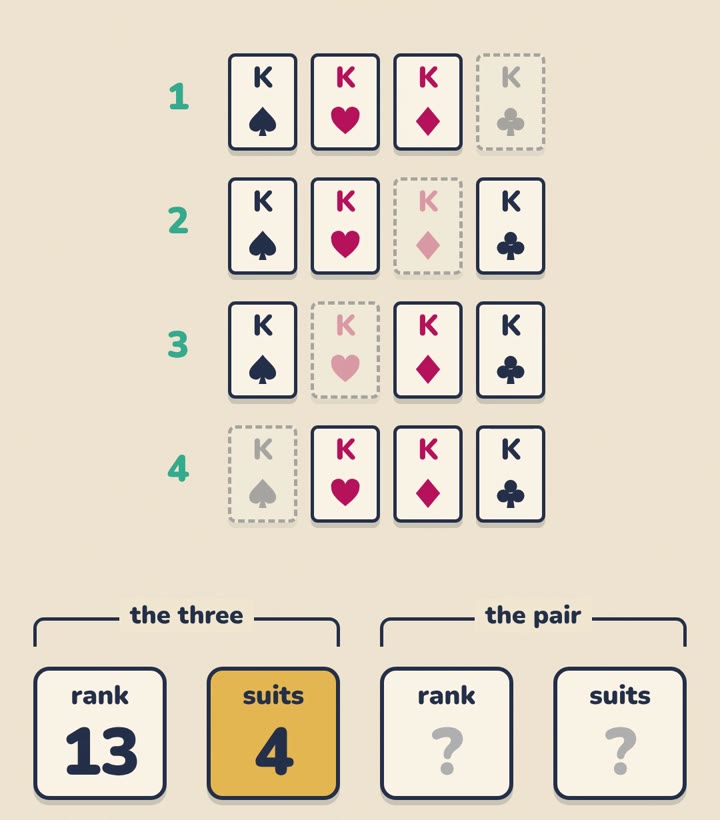
Box 2: the suits of the three. There are four kings, and you keep three of them. That's the same as choosing which one suit to leave out, so there are 4 ways: leave out clubs, diamonds, hearts or spades.
Box 3: the rank of the pair. Any rank except the one you already used, because the pair can't match the three. That leaves 12. Say sevens.
Box 4: the suits of the pair. Two of the four sevens. Listing them: spades and hearts, spades and diamonds, spades and clubs, hearts and diamonds, hearts and clubs, diamonds and clubs. That's 6 ways.
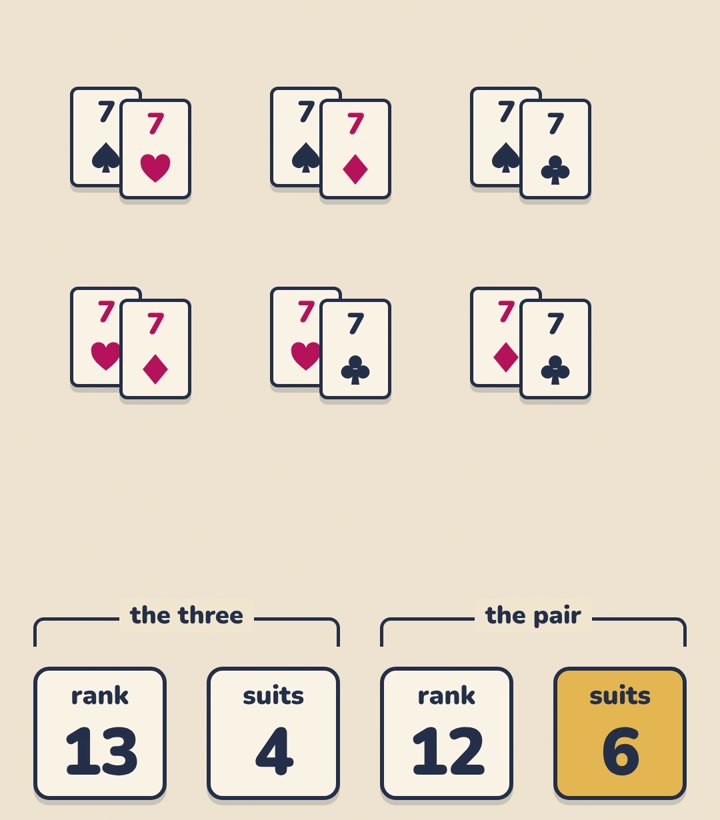
Why do the boxes multiply?
Any choice in one box fits with any choice in the others. Each of the 13 ranks for the three can go with each of its 4 suit choices: 52 ways to pick the three. Each of those goes with each of the 12 ranks for the pair, and each of those with each of the 6 suit pairs. Every combination gives a different full house, and every full house comes from exactly one combination.
| Box | Choice | Ways |
|---|---|---|
| 1 | rank of the three | 13 |
| 2 | its three suits | 4 |
| 3 | rank of the pair | 12 |
| 4 | its two suits | 6 |
| all together | 13 × 4 × 12 × 6 = 3,744 |
How likely is it?
There are 2,598,960 different five-card hands, all equally likely. So the chance of a full house is 3,744 out of 2,598,960, which is about 0.144%, or 1 hand in 694.
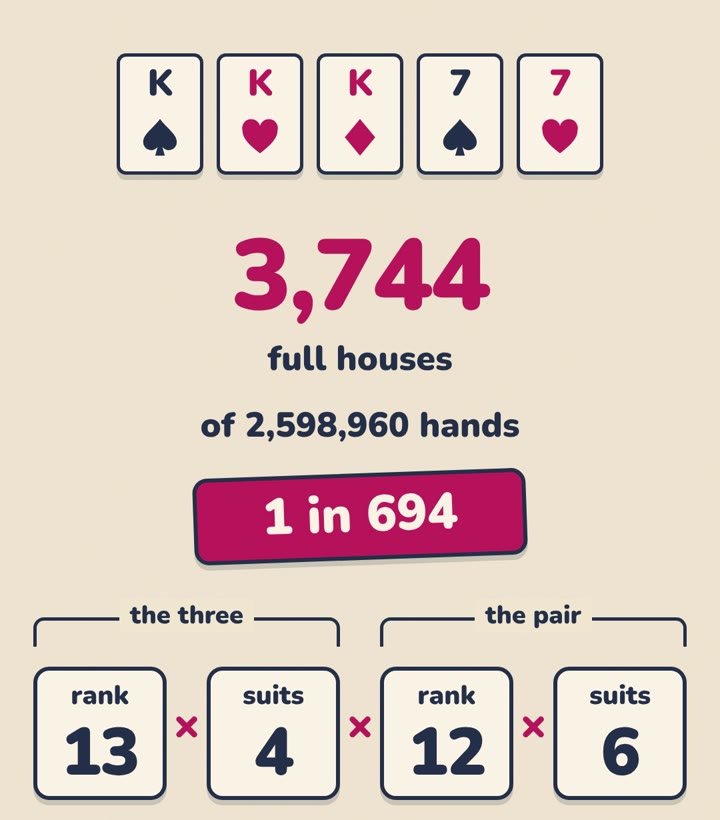
Four small boxes give thousands of full houses, but the deck deals millions of hands, so a full house stays rare.
Check it with code
The script counts the boxes, then goes through every one of the 2,598,960 hands and counts the full houses directly, then deals two million random hands:
from collections import Counter
from fractions import Fraction
from itertools import combinations
import random

DECK = [r + s for r in 'A23456789TJQK' for s in 'SHDC']   # 13 ranks x 4 suits


def is_full_house(hand):
    return sorted(Counter(card[0] for card in hand).values()) == [2, 3]


boxes = [13, len(list(combinations('SHDC', 3))), 12, len(list(combinations('SHDC', 2)))]
print('boxes:', boxes, '->', boxes[0] * boxes[1] * boxes[2] * boxes[3])

total = full = 0
for hand in combinations(DECK, 5):        # every five-card hand, once
    total += 1
    full += is_full_house(hand)
p = Fraction(full, total)
print(f'full houses: {full:,} of {total:,} hands')
print(f'chance: {float(p) * 100:.3f} %, 1 in {total / full:.0f}')

rng = random.Random(9)
deals = 2_000_000
hits = sum(is_full_house(rng.sample(DECK, 5)) for _ in range(deals))
print(f'simulated: {hits / deals * 100:.3f} %')
Output:
boxes: [13, 4, 12, 6] -> 3744
full houses: 3,744 of 2,598,960 hands
chance: 0.144 %, 1 in 694
simulated: 0.146 %
The direct count over every hand agrees with the four boxes, and the simulation lands close to the exact 0.144%.
Try it
Is four of a kind rarer or more common than a full house? Build it with boxes the same way: the rank of the four, then the fifth card. Count it, then change is_full_house in the code to check your answer.