Implicit conversions in C++, byte by byte
Implicit conversions in C++ change the bytes: int 7 becomes 401C000000000000 as a double, char + char is an int, and int 300 narrows to char 44.
What do implicit conversions in C++ do to the bytes in memory? When you assign an int to a double, add two chars, or store an int in a char, the compiler converts the value for you, without a cast. The type changes, and so do the bytes. Here are the real ones.
This is the written version of Understanding C++ #9. Everything below comes from one program, compiled with g++ -std=c++20 -Wall -O2 (GCC 13) on x86-64 Linux, where int is 4 bytes, double is 8 and char is a signed 8-bit byte. The program prints each value in hex, top byte first; in memory, x86-64 stores the lowest byte first.
What happens to the bytes when an int becomes a double?
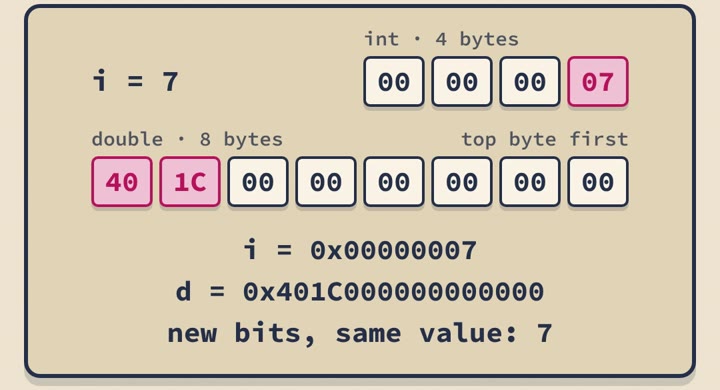
int i = 7; then double d = i;. The sizes print 4 8: four bytes become eight. But the conversion does not copy the four bytes and pad them with zeros. An int stores 7 as a plain binary number, 00000007. A double stores a sign bit, an 11-bit exponent and a 52-bit mantissa (IEEE-754), so the same 7 has to be encoded again from scratch: 401C000000000000.
| variable | type | bytes | hex, top byte first |
|---|---|---|---|
i |
int |
4 | 00000007 |
d |
double |
8 | 401C000000000000 |
Not one bit is in the same place. The low byte of i is 07; the low byte of d is 00. The value is exactly the same, though: a double has 53 bits of precision, more than the 32 bits of an int, so every int converts to a double without loss. To read the double's bits, the program uses std::bit_cast (C++20), which copies the 8 bytes into an unsigned long unchanged.
Why is char + char an int?
char a = 100, b = 100; are one byte each, 64 in hex. Before arithmetic, C++ applies the integral promotions: operands narrower than int, such as char and short, are converted to int first. So a + b is computed as an int, and sizeof(a + b) prints 4, not 1.
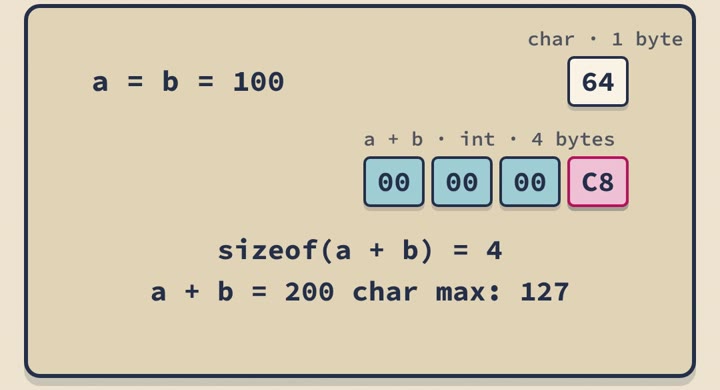
The sum prints 200. A signed char here holds at most 127 (CHAR_MAX), so the sum would not fit in a char, but it was never a char: it is an int holding 000000C8. There is no overflow. The narrowing only happens if you store the result back into a char.
What does narrowing do to the bytes?
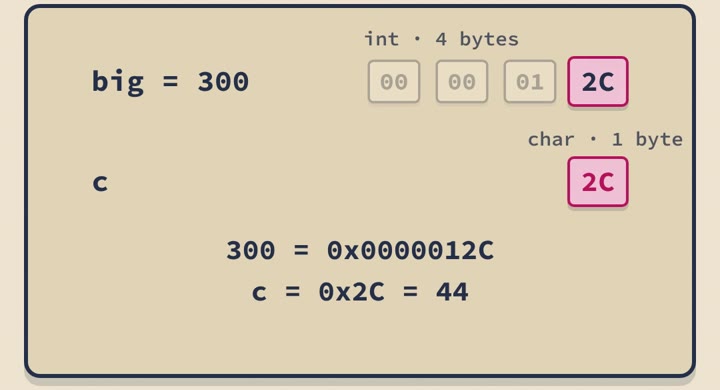
int big = 300; then char c = big;. In hex, 300 is 0000012C. A char has room for one byte, so the conversion keeps the low byte, 2C, and the other three are dropped. 2C is 44, and c prints 44. Since C++20 this result is defined by the standard: converting to a signed integer type gives the value congruent modulo 2 to the power of its width, which here means keeping the low 8 bits. Before C++20 it was implementation-defined, and GCC already did the same.
Brace initialization does not allow this silently. char e{big}; is a narrowing conversion, which the standard makes ill-formed in a list initialization. GCC 13 reports it as a warning (narrowing conversion of 'big' from 'int' to 'char' [-Wnarrowing]) when big is a variable, and as an error for the constant char e{300};. Either way, braces make the compiler tell you.
What is the difference, in one line?
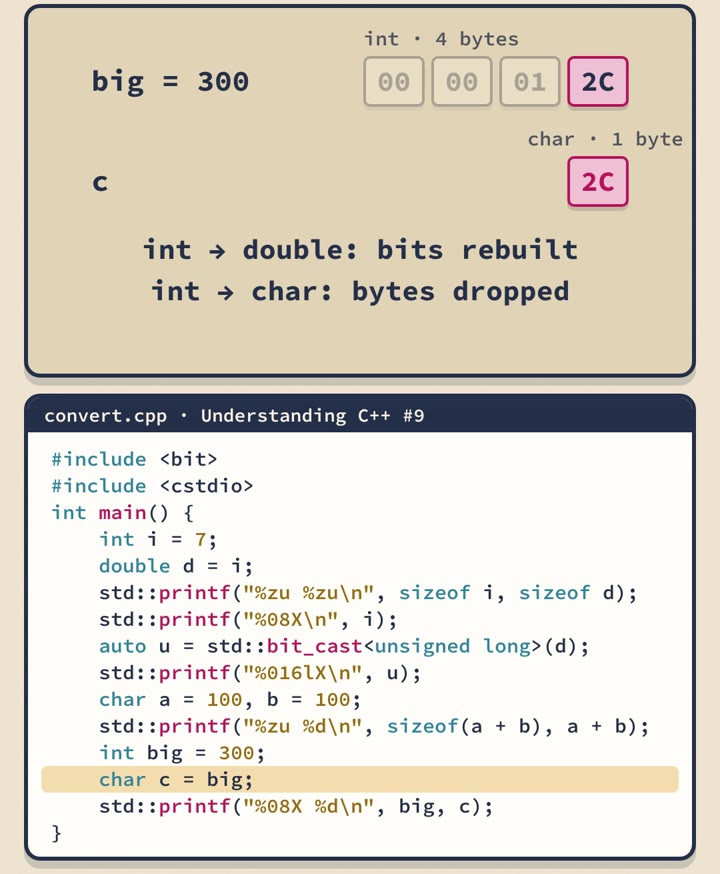
int to double rebuilds the bits into a new encoding of the same value. int to char drops the high bytes and keeps what was in the low one.
The program and its output
#include <bit>
#include <cstdio>
int main() {
    int i = 7;
    double d = i;
    std::printf("%zu %zu\n", sizeof i, sizeof d);
    std::printf("%08X\n", i);
    auto u = std::bit_cast<unsigned long>(d);
    std::printf("%016lX\n", u);
    char a = 100, b = 100;
    std::printf("%zu %d\n", sizeof(a + b), a + b);
    int big = 300;
    char c = big;
    std::printf("%08X %d\n", big, c);
}
4 8
00000007
401C000000000000
4 200
0000012C 44
Line by line: 4 8 are the sizes of i and d; 00000007 is i; 401C000000000000 is the bit pattern of d; 4 200 are sizeof(a + b) and the sum; 0000012C 44 are big in hex and c after the narrowing.
Try it
Store 256 in a char: what prints? Write 256 in hex first and look at its low byte, then run it on your own compiler.