The false positive paradox: a 99% accurate test, 9% sick
A 99% accurate test for a disease 1 in 1,000 people have: you test positive. Lay out 1,000 people and count: only about 9% of positives are sick.
The false positive paradox goes like this: a test for a disease is 99% accurate, and you test positive. Are you probably sick? The tempting answer is yes, 99%. When the disease is rare, the real answer is closer to 9%. The way to see why is to lay out every person and count.
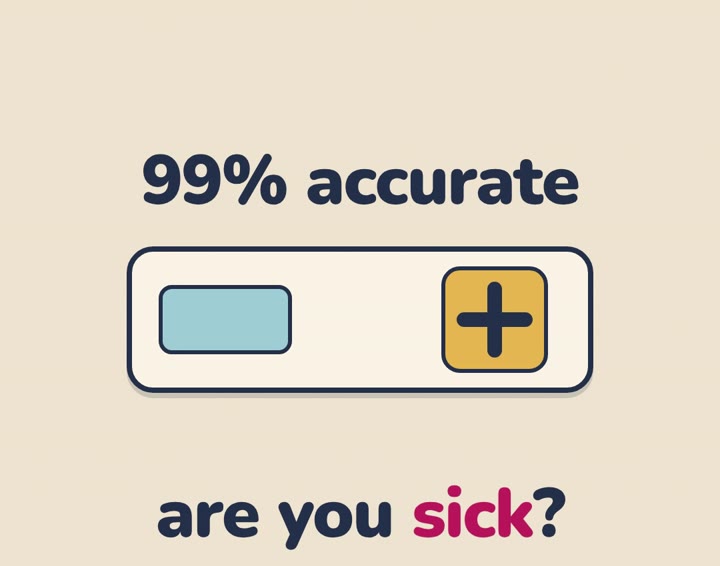
What are the rules?
Two facts, stated in plain numbers:
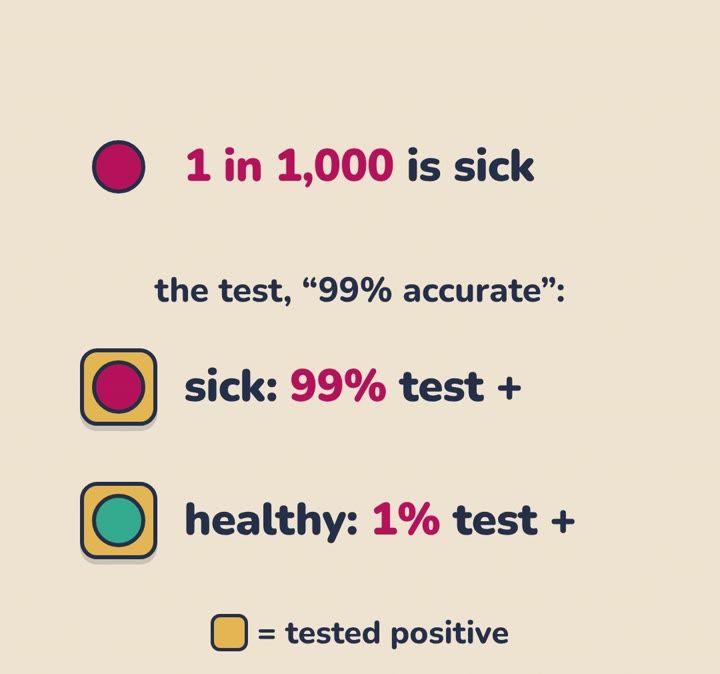
- The disease: 1 person in 1,000 has it.
- The test, "99% accurate": it comes back positive for 99% of sick people, and it wrongly comes back positive for 1% of healthy people.
"99% accurate" has to mean both of those things here: it catches almost every sick person, and it makes a mistake on 1 healthy person in 100.
What happens to 1,000 people?
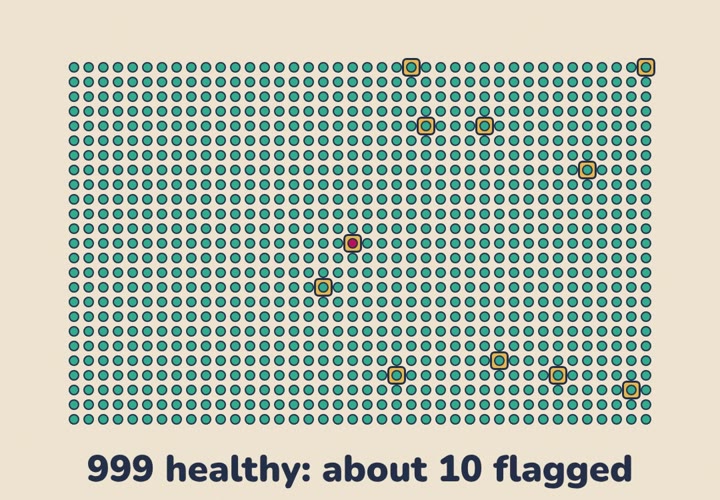
Take 1,000 people and test them all. On average:
- 1 is sick. The test catches them 99% of the time, so that's about 1 true positive (0.99 on average).
- 999 are healthy. The test wrongly flags 1% of them, so that's about 10 false positives (9.99 on average).
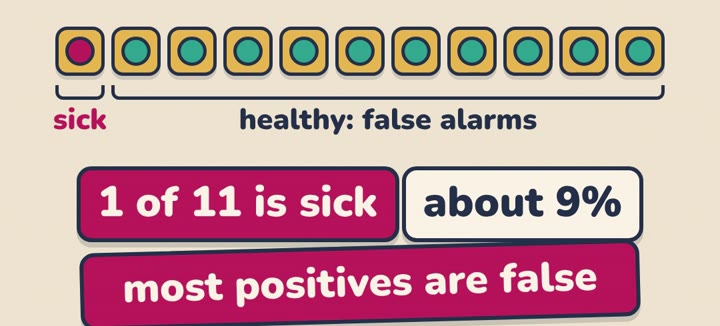
In the picture, each person is a dot. The sick one is berry, and everyone who tests positive sits on a mustard tile. One tile holds the sick person. The other ten hold healthy people.
How many positives are really sick?
Gather everyone who tested positive into one row: about 11 people. Only 1 of them is sick. So if all you know is "I tested positive", you're one of those 11, and the chance you're the sick one is about 1 in 11, about 9%.
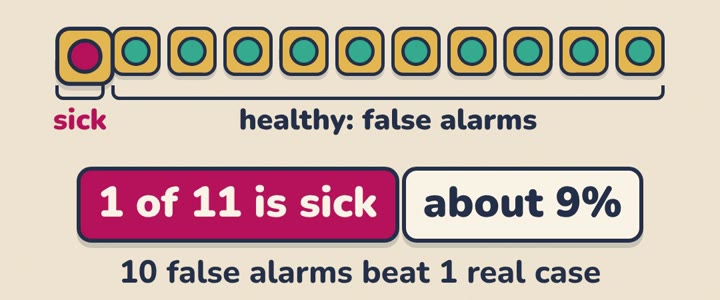
Exactly, with the averages kept as fractions: 0.99 true positives out of 0.99 + 9.99 = 10.98 positives, which is 11/122, or 9.0%.
| Per 1,000 people | Test positive | Test negative |
|---|---|---|
| Sick (1) | 0.99 | 0.01 |
| Healthy (999) | 9.99 | 989.01 |
| All | 10.98 | 989.02 |
Why are most positives false?
The test's mistakes are rare, 1 in 100, but they happen to a huge crowd: 999 healthy people. One percent of a big number is still about 10 people, and 10 false alarms outnumber the 1 real case. When a disease is rare, most positives are false, even from a good test. This is also called the base rate fallacy: the mistake is ignoring how rare the disease is to begin with.
Check it with code
The script counts the expected positives in 1,000 people with exact fractions, then tests two million simulated people and checks how many of the positives were really sick:
from fractions import Fraction
import random

sick_rate = Fraction(1, 1000)       # 1 person in 1,000 has the disease
catch = Fraction(99, 100)           # the test is positive for 99% of sick people
false_alarm = Fraction(1, 100)      # ...and for 1% of healthy people

people = 1000
sick = people * sick_rate                     # 1 on average
true_pos = sick * catch                       # 0.99
false_pos = (people - sick) * false_alarm     # 9.99
print('positives per 1,000 people:', true_pos, '+', false_pos, '=', float(true_pos + false_pos))
p = true_pos / (true_pos + false_pos)
print('chance a positive is sick:', p, f'= {float(p):.1%}')

rng = random.Random(12)
pos = pos_sick = 0
for _ in range(2_000_000):
    is_sick = rng.random() < 1 / 1000
    if rng.random() < (0.99 if is_sick else 0.01):
        pos += 1
        pos_sick += is_sick
print(f'simulated: {pos:,} positives, {pos_sick:,} of them sick -> {pos_sick / pos:.4f} (exact {float(p):.4f})')
Output:
positives per 1,000 people: 99/100 + 999/100 = 10.98
chance a positive is sick: 11/122 = 9.0%
simulated: 21,858 positives, 1,996 of them sick -> 0.0913 (exact 0.0902)
Try it
Same test, but now 1 person in 100 has the disease. You test positive. What's the chance you're sick? Lay out 1,000 people again: how many are sick and caught, and how many healthy people get flagged?