The boy-girl paradox: why the answer is 1 in 3
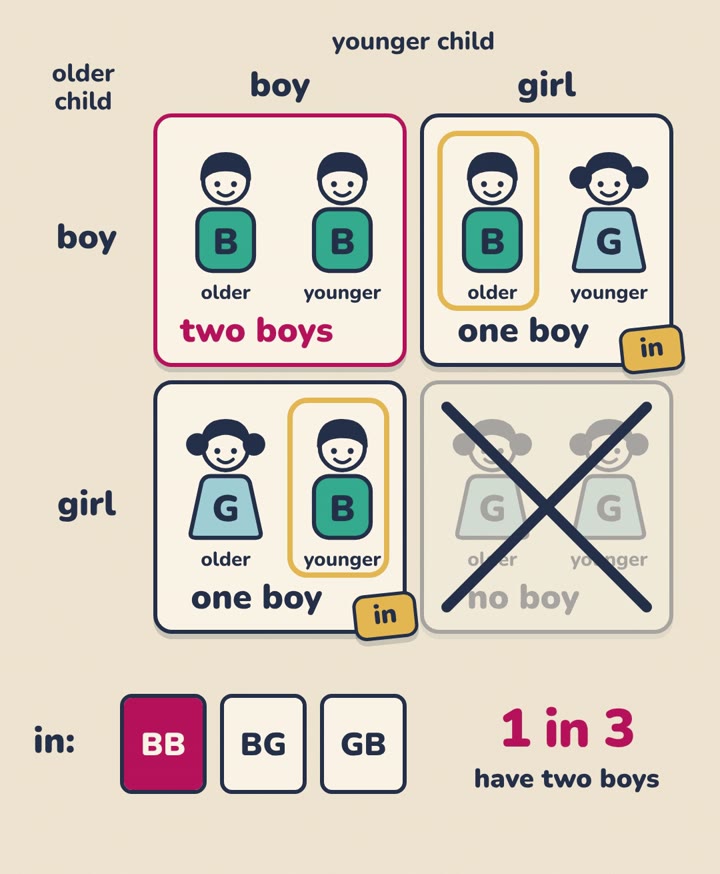
The boy-girl paradox: of all two-child families with at least one boy, what fraction have two boys? Count the four families: 1 in 3.
The boy-girl paradox (also called the two child problem) asks: of all families with two children and at least one boy, what fraction have two boys? Most people say one half. The answer is one in three, and you can see why by laying out every family and counting.
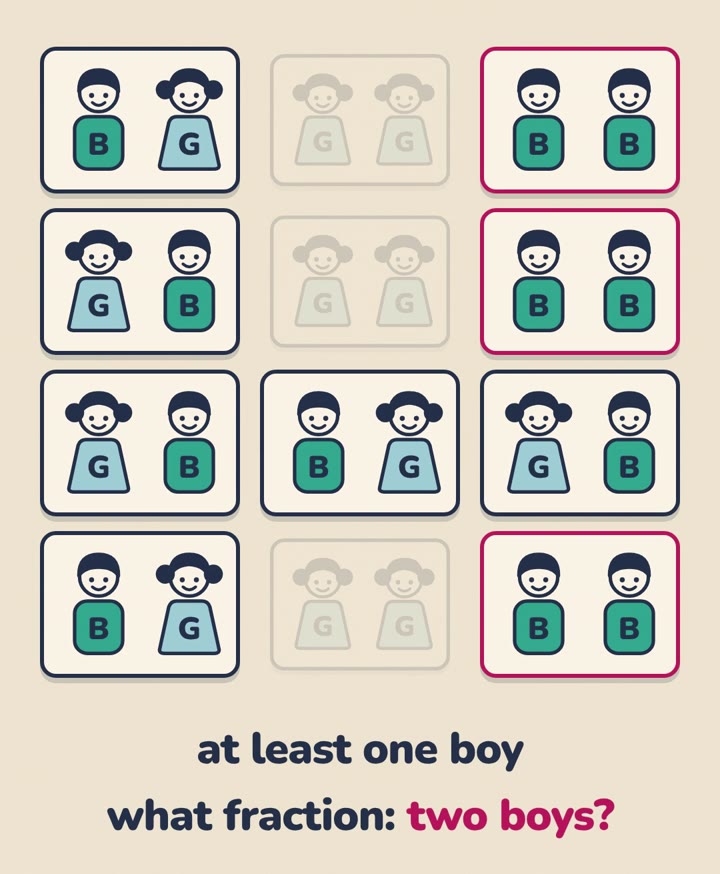
The wording matters, so here it is precisely. Picture every two-child family. Throw away the ones with no boy at all. Of the families that are left, how many have two boys?
What are the rules?
Each child is a boy or a girl, equally likely, and one child's sex doesn't affect the other's. Real birth ratios are a little off fifty-fifty, but the puzzle uses these simple rules, and so do we.
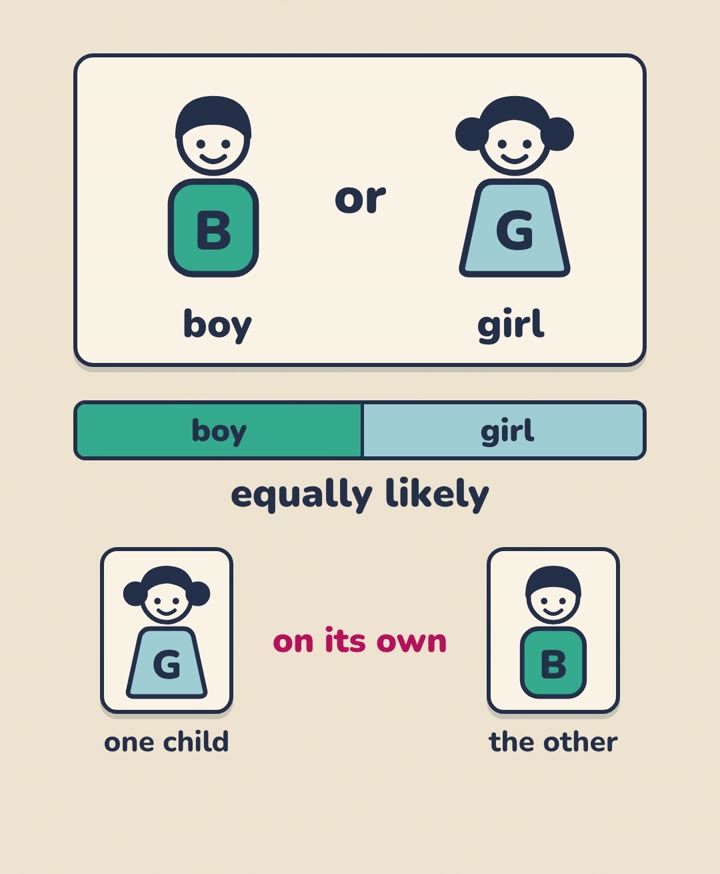
What are the equally likely cases?
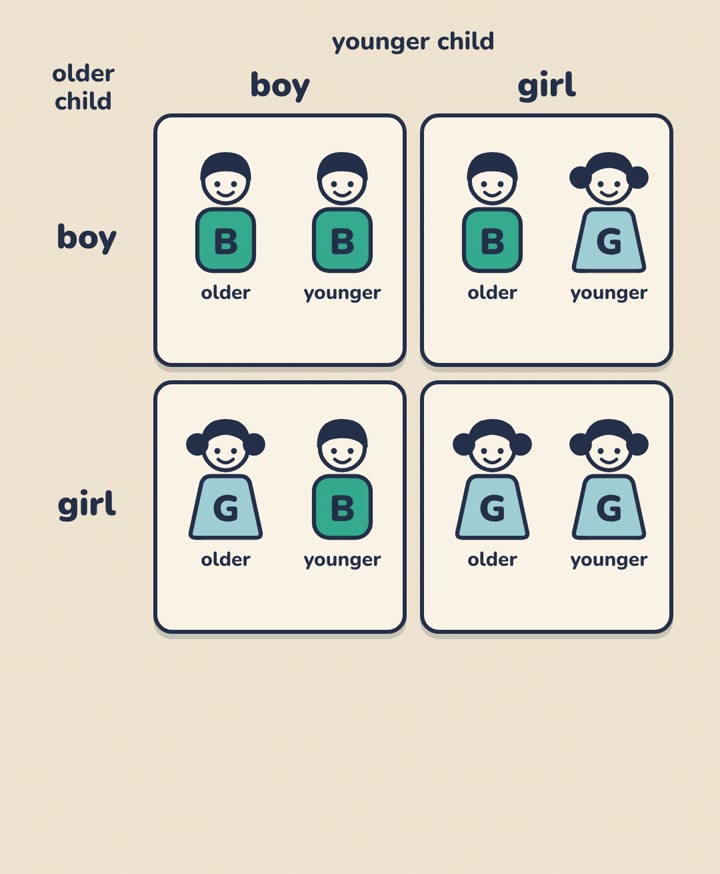
Line the children up by age: the older child first, then the younger. Each can be a boy (B) or a girl (G), so there are four kinds of family:
| Older | Younger | Family | Boys |
|---|---|---|---|
| boy | boy | BB | 2 |
| boy | girl | BG | 1 |
| girl | boy | GB | 1 |
| girl | girl | GG | 0 |
Because each child is fifty-fifty on its own, the four are equally likely: each is a quarter of all two-child families. Notice that BG and GB are different families. A family with an older son and a younger daughter isn't the same as one with an older daughter and a younger son, and together they're twice as common as BB.
Which families stay in?
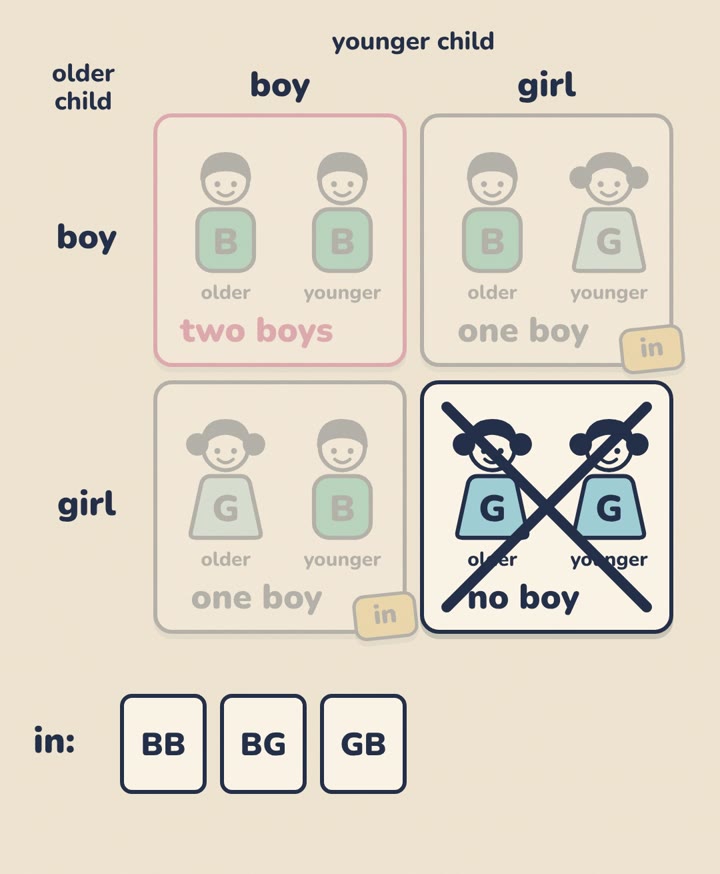
Play them out one at a time and ask: does this family have at least one boy?
- Boy, then boy: two boys. It stays in.
- Boy, then girl: one boy. It stays in.
- Girl, then boy: one boy. It stays in too.
- Girl, then girl: no boy. Cross it out.
Count
Three families are left, and they're still equally likely, since crossing out GG doesn't change how common the others are. Only one of the three, BB, has two boys. So among families with at least one boy, 1 in 3 have two boys.
Why isn't it one half?
"At least one boy" rules out two girls, but it doesn't say which child is the boy. He could be the older child (BG), the younger (GB), or both are boys (BB). The two one-boy families together outnumber the two-boy family two to one.
The half answer comes from a different question. If you meet one of the two children at random and it's a boy, a BB family is twice as likely to show you a boy as a BG or GB family, and that weighting brings the answer back to 1 in 2. The puzzle is famous because a small change in how you learn about the boy changes the answer.
Check it with code
Count the four families exactly, then simulate 400,000 random two-child families and keep only those with a boy:
from fractions import Fraction
from itertools import product
import random

families = [''.join(f) for f in product('BG', repeat=2)]   # older, younger: BB, BG, GB, GG
left = [f for f in families if 'B' in f]                    # at least one boy
print('families:', families)
print('at least one boy:', left)
print('two boys:', Fraction(left.count('BB'), len(left)))

rng = random.Random(5)
fams = [rng.choice('BG') + rng.choice('BG') for _ in range(400_000)]
kept = [f for f in fams if 'B' in f]
print(f'simulated: {kept.count("BB") / len(kept):.4f}')
Output:
families: ['BB', 'BG', 'GB', 'GG']
at least one boy: ['BB', 'BG', 'GB']
two boys: 1/3
simulated: 0.3324
Try it
Now say you're told the older child is a boy. What's the chance both children are boys? Use the same grid: which families are left, and how many of them have two boys?