The boy born on a Tuesday problem: why the answer is 13/27
The boy born on a Tuesday problem: two kids, at least one a boy born on a Tuesday. Count 196 families and 13 of the 27 left have two boys.
The boy born on a Tuesday problem goes like this: a family has two children, and at least one of them is a boy born on a Tuesday. What's the chance both children are boys? The weekday sounds like it can't matter. It does: the answer is 13/27, about 48 %, up from the 1 in 3 of the plain boy-girl paradox.
What are the rules?
Each child is a boy or a girl, equally likely, and is born on any of the seven days of the week, also equally likely. One child doesn't affect the other. Real births aren't spread perfectly evenly, but the puzzle uses these simple rules, and so do we.
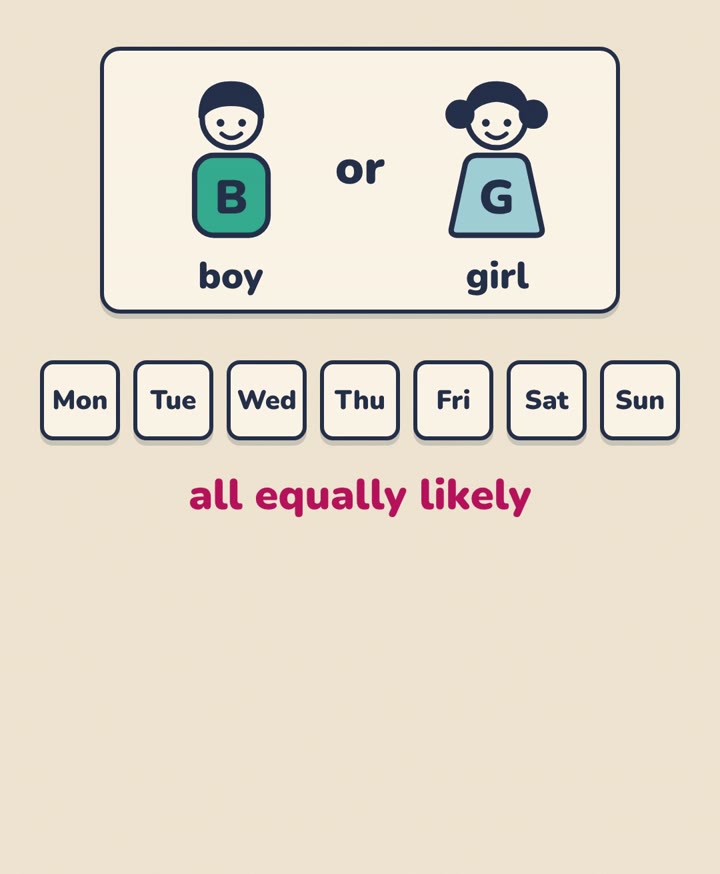
What are the equally likely cases?
Combine the two rules and every child is one of 14 equally likely kinds: a boy born on Monday, a boy born on Tuesday, and so on through a girl born on Sunday. Put the older child's kind down the side and the younger child's across the top. That's a 14 by 14 grid: 196 families, each exactly as likely as any other.
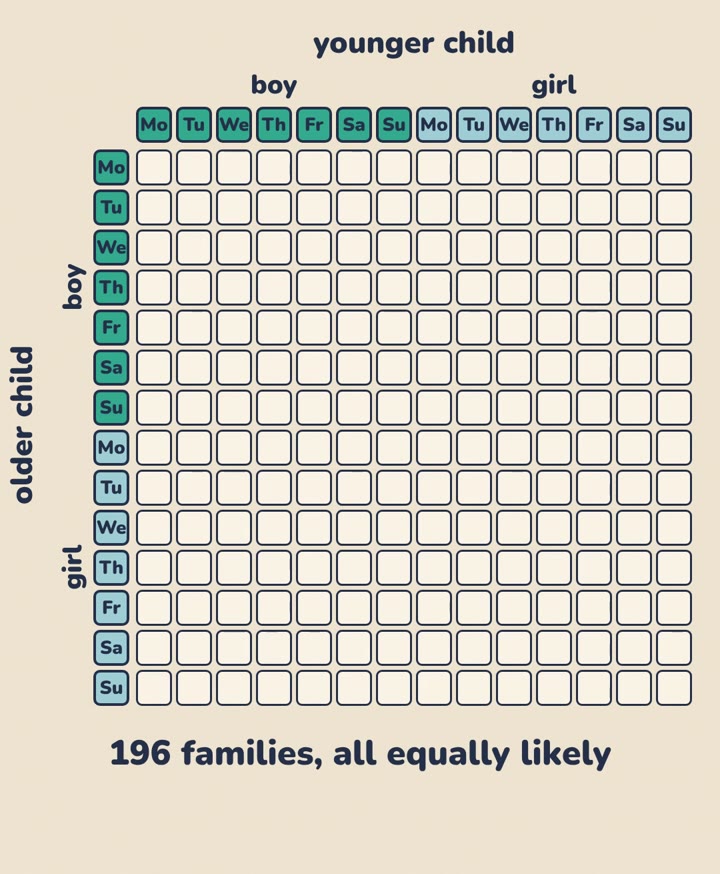
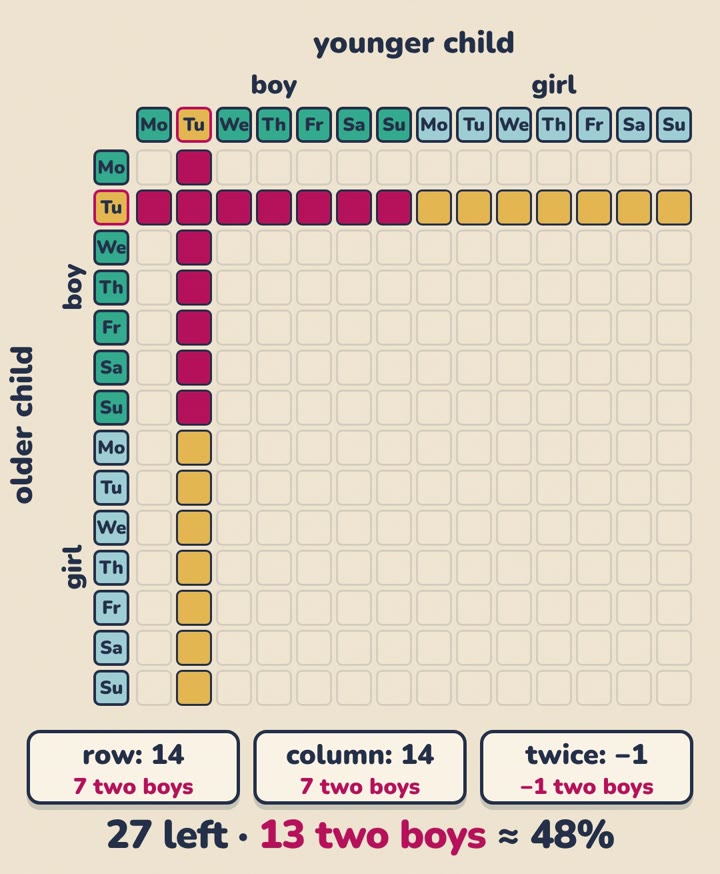
Which families have a Tuesday boy?
There are 196 families, too many to play out one at a time, so play them out a row and a column at a time.
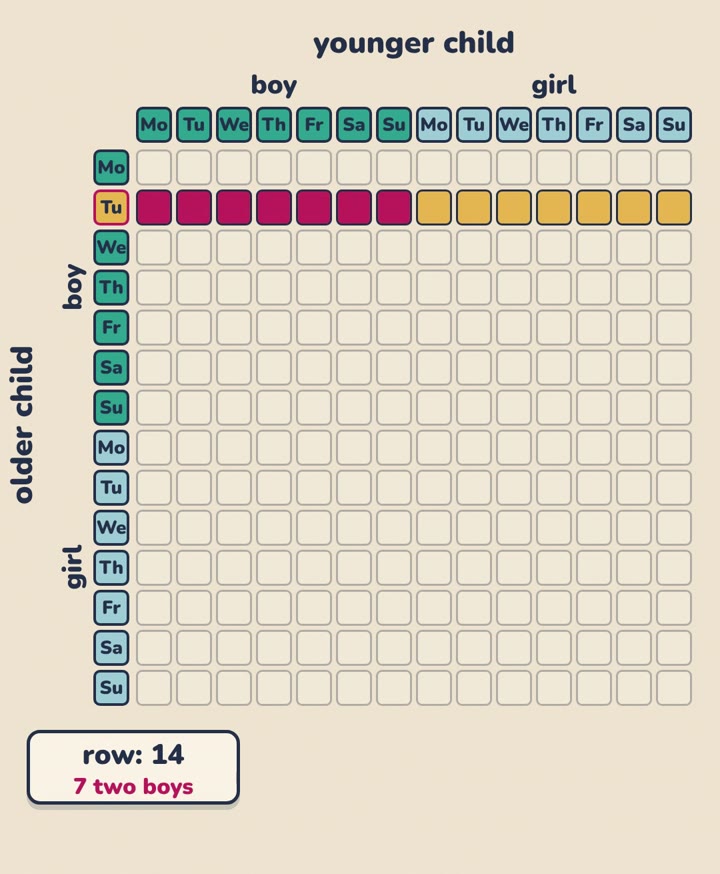
- The older child is a Tuesday boy. That's one whole row: 14 families. In 7 of them the younger child is a boy too (any day), and in the other 7 a girl.
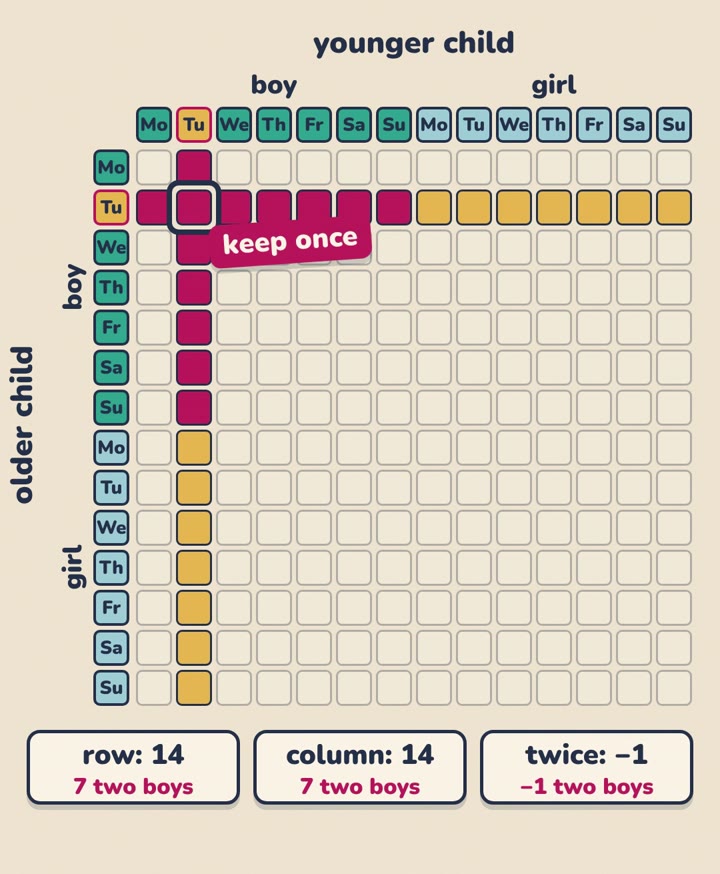
- The younger child is a Tuesday boy. That's one whole column: 14 more families, 7 of them with an older brother.
The row and the column cross in one cell: the family where both children are Tuesday boys. It's in the row and in the column, so adding 14 and 14 counts it twice. Keep it once.
Count
| Group | Families | Two boys |
|---|---|---|
| Older child a Tuesday boy (row) | 14 | 7 |
| Younger child a Tuesday boy (column) | 14 | 7 |
| Both Tuesday boys (counted twice) | −1 | −1 |
| Left | 27 | 13 |
So 27 equally likely families are left, and 13 of them have two boys. The chance is 13/27, about 48 %.
Why does the Tuesday change the answer?
A family with two boys has two chances for one of them to be born on a Tuesday; a family with one boy has only one. So the Tuesday detail catches two-boy families nearly twice as often, and that pulls the answer up from 1 in 3 toward 1 in 2. It can't quite get there, because the one family with two Tuesday boys gets only one cell, not two.
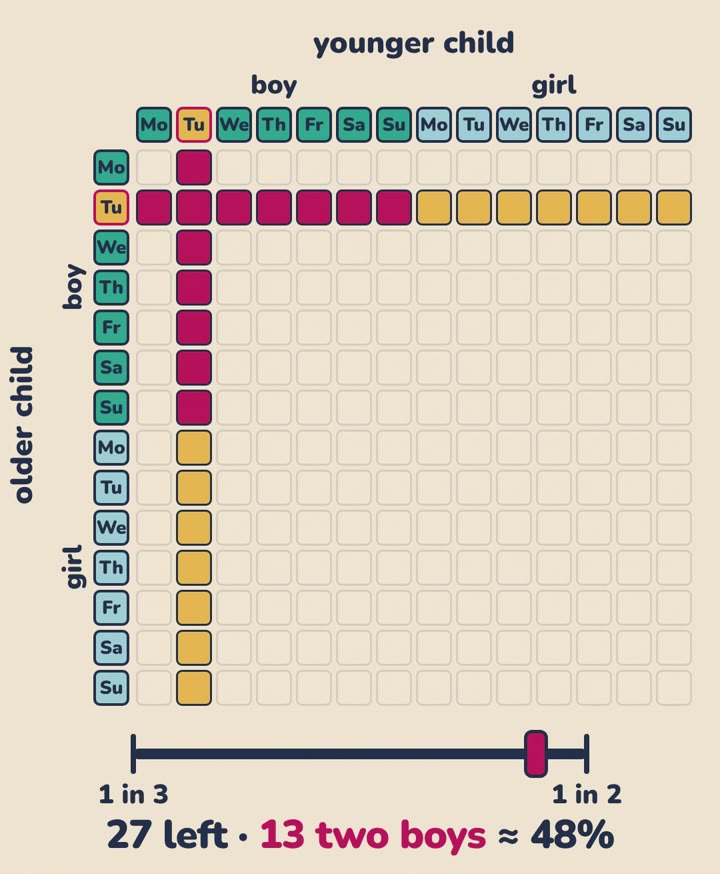
The rarer the detail, the closer the answer gets to a half. With no detail at all ("at least one is a boy") every boy matches, a two-boy family gets no extra chance, and the answer is the 1 in 3 from the boy-girl paradox.
Check it with code
Count the 196 families exactly, then simulate 2,000,000 random two-child families and keep only those with a Tuesday boy:
from fractions import Fraction
from itertools import product
import random

DAYS = ['Mo', 'Tu', 'We', 'Th', 'Fr', 'Sa', 'Su']
kinds = [(s, d) for s in 'BG' for d in DAYS]           # 14 kinds of child
fams = list(product(kinds, repeat=2))                  # (older, younger): 196 families
left = [f for f in fams if ('B', 'Tu') in f]           # at least one Tuesday boy
two = [f for f in left if f[0][0] == f[1][0] == 'B']
print('families:', len(fams))
print('with a Tuesday boy:', len(left))
print('two boys:', len(two), '->', Fraction(len(two), len(left)))

rng = random.Random(6)
kept = bb = 0
for _ in range(2_000_000):
    a = (rng.choice('BG'), rng.choice(DAYS)); b = (rng.choice('BG'), rng.choice(DAYS))
    if ('B', 'Tu') in (a, b):
        kept += 1
        bb += a[0] == b[0] == 'B'
print(f'simulated: {bb / kept:.4f}')
Output:
families: 196
with a Tuesday boy: 27
two boys: 13 -> 13/27
simulated: 0.4792
Try it
Now say the boy was born in December instead of on a Tuesday, with all twelve months equally likely. Is the chance of two boys higher or lower than 13/27? Build the same grid with 24 kinds of child and count the row and the column.