At least one six in four rolls: de Méré's bet, counted
Roll a die four times: is at least one six more likely than not? Count the rolls with no six instead, and 671 of the 1296 sequences win.
At least one six in four rolls: roll a single die four times, and you win if a 6 shows up at least once. Is that more likely than not? It's one of the oldest questions in probability. In 17th-century France the Chevalier de Méré made money betting on it, and the reason it works is a trick worth keeping: when you want "at least one", count "none at all" instead.
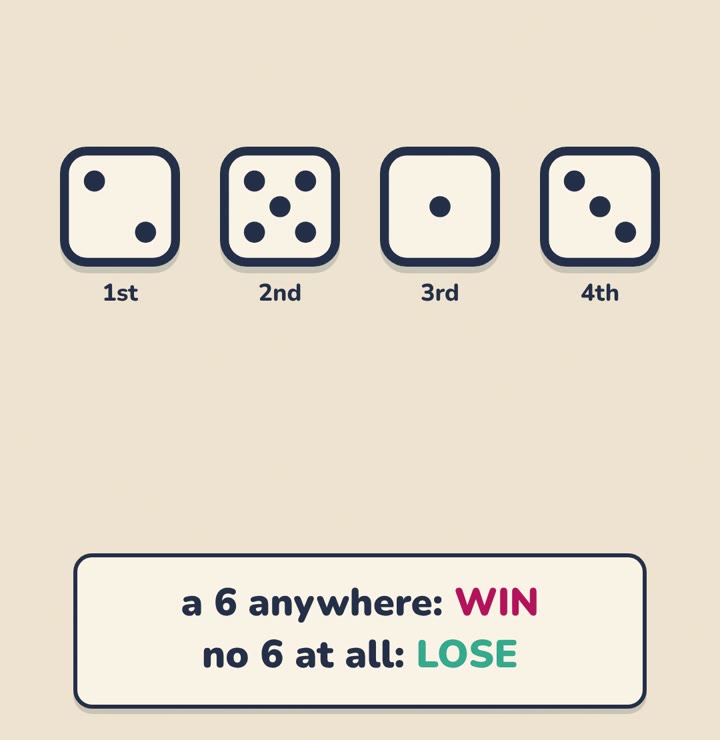
What are the rules?
One die, four rolls. Each roll lands on 1, 2, 3, 4, 5 or 6, every face equally likely, and the rolls don't affect each other. If any of the four rolls is a 6, you win. If none of them is, you lose.
The equally likely cases are the sequences of four rolls, like 3, 1, 6, 4 or 2, 5, 1, 3. There are 6 × 6 × 6 × 6 = 1296 of them. That's too many to list one by one, so don't count the winners. Count the losers.
Why count the losers?
A winning sequence can have its 6 on the first roll, the second, the third, the fourth, or on several of them at once. Counting all of that without double counting is fiddly. A losing sequence is simple: every roll is one of 1 to 5. Count those, and every other sequence is a win.
How do the losers shrink, roll by roll?
Think of a tree that only keeps the branches with no six.
First roll. Six faces, and five of them aren't a 6. So 5 of the 6 first rolls are still losing.
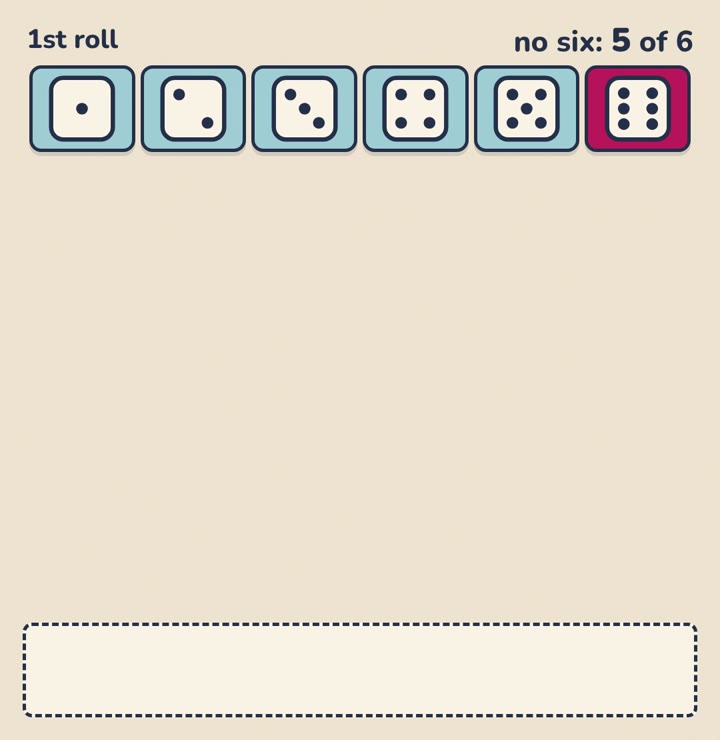
Second roll. Each of those 5 survivors splits six ways, and again five of the six are safe. That leaves 5 × 5 = 25 of the 36 two-roll sequences with no six. The other 11 already have a 6, and nothing later can take it away.
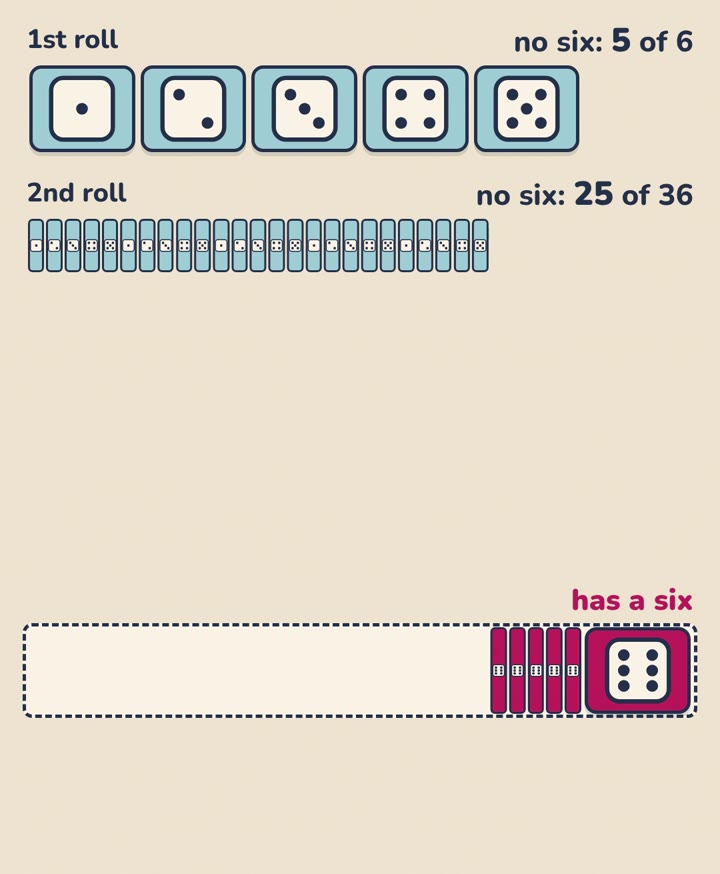
Third roll. 25 survivors, each splitting six ways, five safe: 125 of 216.
Fourth roll. 125 survivors, five safe each: 625 of 1296 sequences never see a six.
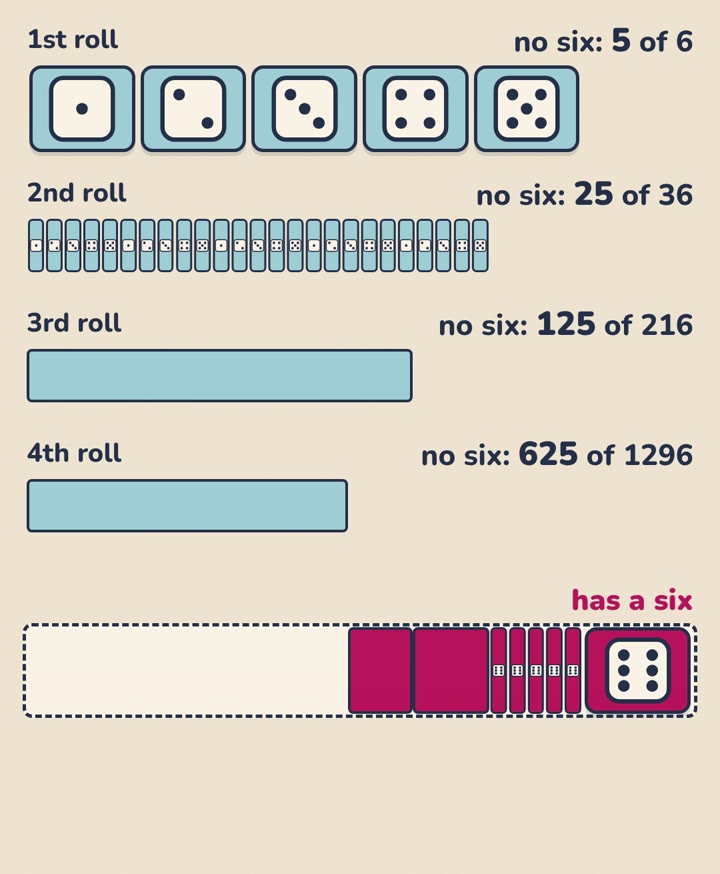
| After roll | No six | All sequences |
|---|---|---|
| 1 | 5 | 6 |
| 2 | 25 | 36 |
| 3 | 125 | 216 |
| 4 | 625 | 1296 |
So what is the probability of at least one six?
Every sequence that isn't a loser has at least one 6: 1296 − 625 = 671 of 1296, which is about 51.8%. Just over half, so the bet is (slightly) in your favour.
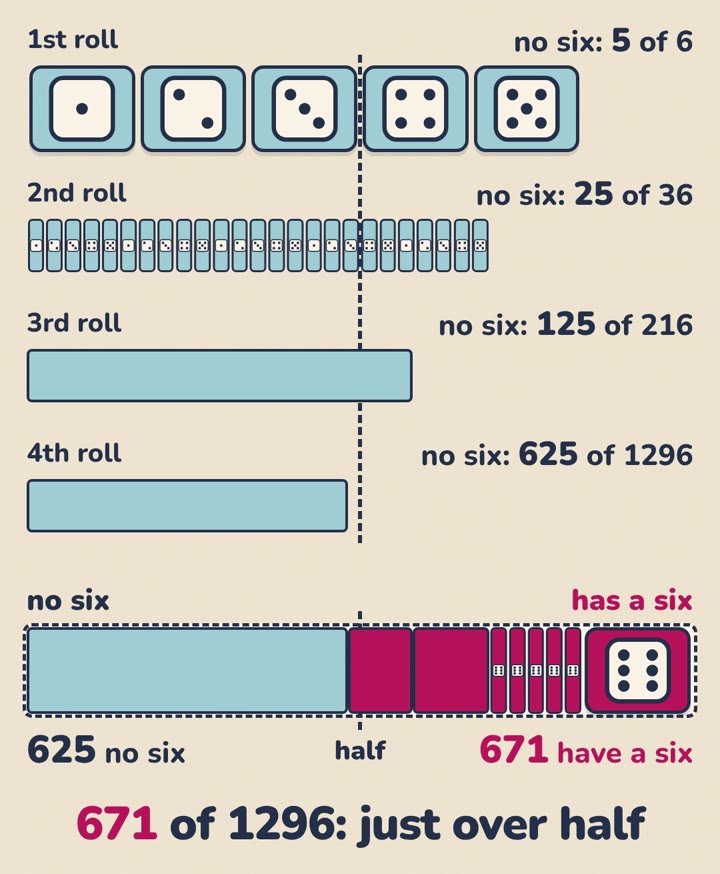
You can also see where the 671 come from. The first 6 lands on roll 1 in 216 sequences, on roll 2 in 180, on roll 3 in 150 and on roll 4 in 125. Those add up to 671.
Why does it work?
Each roll keeps only five sixths of the losers alive. Starting from all of them, that's five sixths, then five sixths of that, and so on. After three rolls the losers are still more than half (125 of 216), but the fourth roll pushes them under half (625 of 1296). "At least one" is everything except "none at all", so once the losers drop below half, the winners are above it.
Written as a formula, it's 1 − (5/6)⁴ = 671/1296. The formula is just the count of losers, flipped.
Check it with code
Count every sequence exactly, then simulate 400,000 games of four rolls:
from fractions import Fraction
from itertools import product
import random

for k in range(1, 5):
    seqs = list(product(range(1, 7), repeat=k))       # every equally likely sequence of k rolls
    none = sum(6 not in s for s in seqs)               # the losers: no six at all
    print(f'roll {k}: {none} of {len(seqs)} have no six')

some = len(seqs) - none
print('at least one six:', some, 'of', len(seqs), '=', Fraction(some, len(seqs)), f'= {some / len(seqs):.4f}')

rng = random.Random(4)
n = 400_000
hits = sum(any(rng.randint(1, 6) == 6 for _ in range(4)) for _ in range(n))
print(f'simulated: {hits / n:.4f}')
Output:
roll 1: 5 of 6 have no six
roll 2: 25 of 36 have no six
roll 3: 125 of 216 have no six
roll 4: 625 of 1296 have no six
at least one six: 671 of 1296 = 671/1296 = 0.5177
simulated: 0.5171
The simulated games land right next to the exact 671/1296.
Try it
De Méré had a second bet: roll two dice twenty-four times and win if a double six shows up at least once. Is that better or worse than even? Use the same trick: count the rolls that are not a double six (35 of the 36 pairs) and see how they shrink over 24 rolls.